
Dining room flooring: what the room asks for
Dining room flooring has a job other rooms do not give it: chairs pulled out and pushed back across the same patch of floor at every meal. What wears first is the finish, not the wood. The decision turns on how a floor hides fine scratches, handles spills and can be renewed later.
For a typical dining room, that points to engineered oak with a low-sheen finish, some texture or natural character, and a top layer thick enough to sand. Where it goes wrong is a glossy, smooth, very uniform floor under a table that gets daily use. Below is what the room asks for, in the order we would check it.
Chairs are the real traffic
A dining room sees less foot traffic than a hallway, but it sees a very particular kind. Every chair leg slides back and forth over the same arc, and each slide drags whatever grit is on the floor with it.
That grit is what scratches. The marks sit in the finish, the clear coat on top of the wood, long before they reach the oak underneath.
So the questions for a dining room floor are practical. How well does the surface hide fine scratches, and what can be done when it no longer does?
Felt pads on every chair leg do more than any floor choice. They wear through and collect grit themselves, so check them and replace them when they flatten.
Finish and texture hide the marks
Sheen decides how visible fine scratches are. A glossy finish reflects light evenly, so every scratch breaks the reflection and catches the eye.
Every Monarch Plank floor named in this article lists a UV Urethane, Ultra-Matte finish. Low sheen scatters light instead of mirroring it, which makes a fine scratch much harder to see from standing height.
Texture adds a second layer of disguise. A wire-brushed surface already carries small variations in the grain, so a new scuff blends into marks that were put there on purpose. Monarch Plank Lago - Herringbone Devero shows that kind of surface in the close-up below.
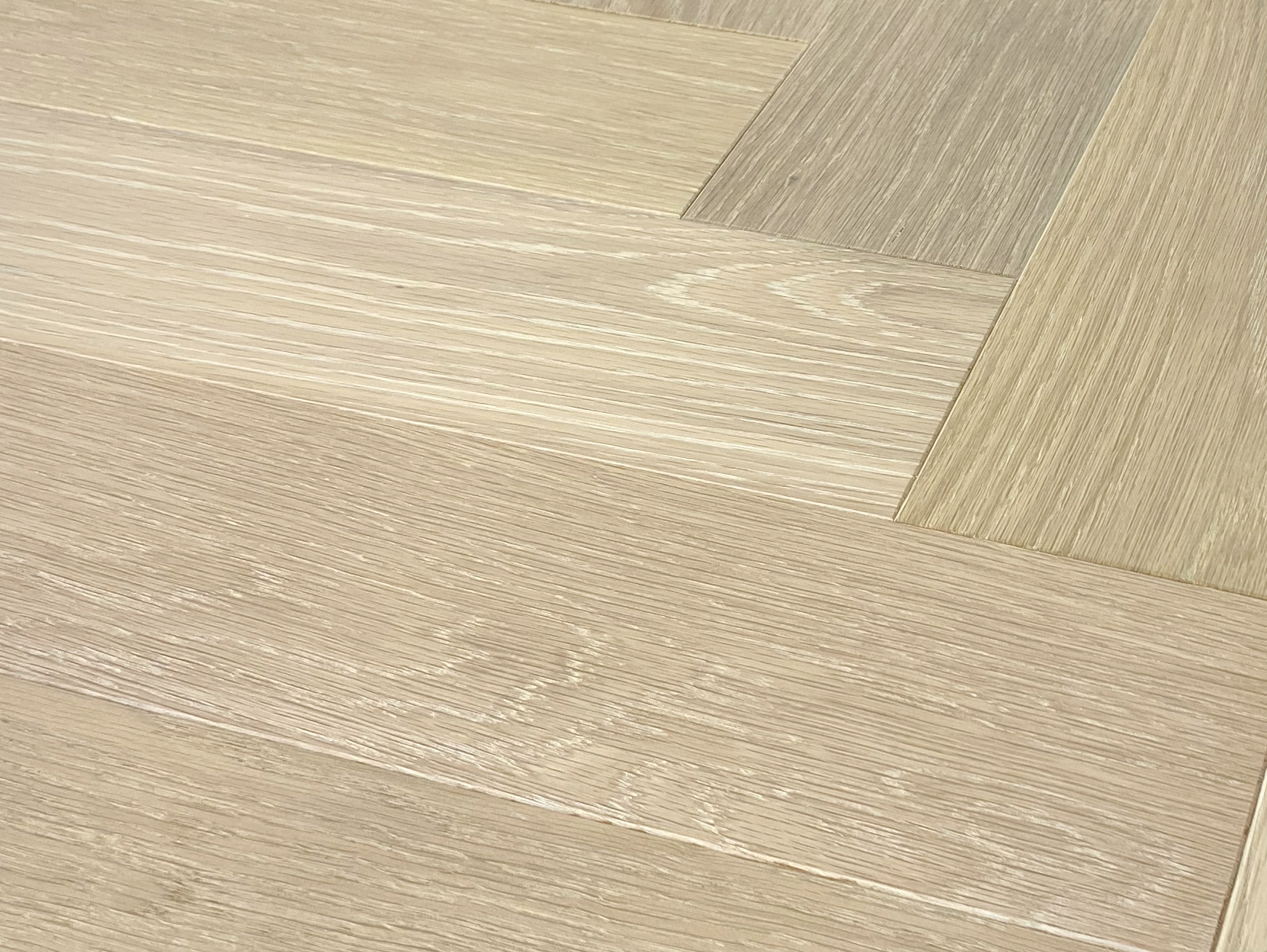
The trade-off is cleaning. Deep texture holds fine dust and crumbs a little longer, so a brushed floor under a dining table suits a vacuum with a soft floor head better than a quick sweep.
Smooth surfaces sit on the other side of that choice. Reward URBANO Euro Oak Palermo lists a Smooth finish, which wipes clean easily, and its Light Rustic grade brings knots and colour movement that help disguise wear.
Character, colour and grade
Uniform colour is unforgiving under a dining table. A clean, pale, knot-free floor shows every scuff, every dent and every crumb against an even background.
Character grades work the other way. Knots, filled pinholes and colour changes from plank to plank give the eye plenty to look at, so everyday wear reads as part of the floor.
Monarch Plank Domaine II - Herringbone Verte is a clear example. Its close-up below shows a large knot, dark filled pinholes and a warm brown tone.
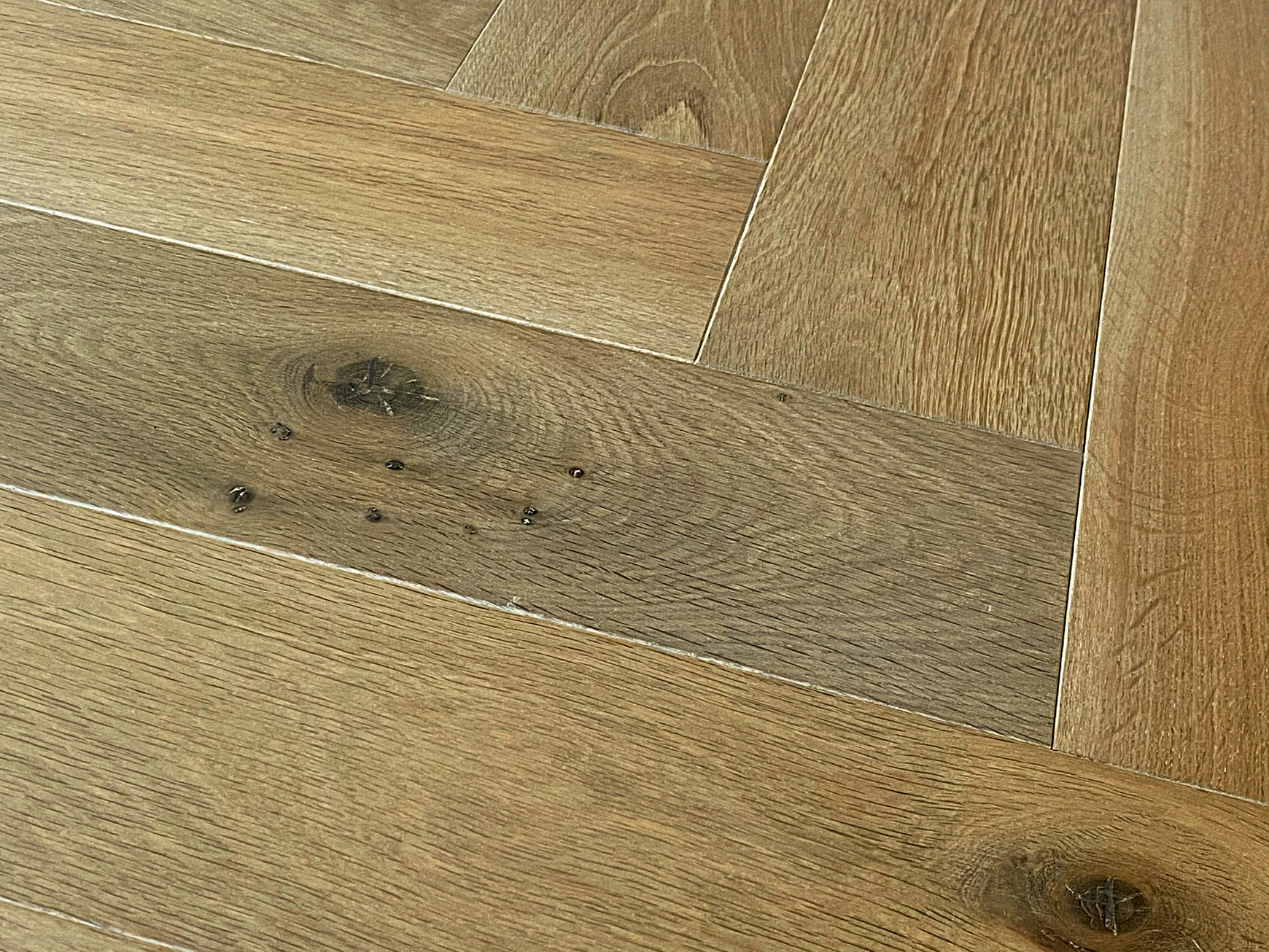
Look closely and you can also see bevelled joints between the herringbone pieces. Bevels hide small height differences between boards, but they also give crumbs somewhere to settle, which matters more under a dining table than in a bedroom.
Mid-tones are the forgiving middle. Very dark floors show dust and pale crumbs, and very pale floors show dark spills and grit, while warm mid-browns and greiges hide both reasonably well.
Spills, table legs and what oak will not forgive
None of the wood floors named here is sold as waterproof, and a dining room gets spills. Water, wine and sauce wiped up promptly are rarely a problem for a finished oak floor.
Standing liquid is different. Left under a table overnight, or allowed to seep into a joint, water can mark the finish and swell the edges of the wood.
If your dining table is where small children eat every meal, or the room works as a messy extension of the kitchen, oak asks for more care than you may want to give. A waterproof vinyl plank is the more forgiving floor in that situation, and we would rather say so before you buy.
Oak is a hardwood, but a narrow chair leg or a heavy table on small feet can still dent it. Wide, flat glides spread the weight, and they are worth fitting before the table comes back into the room.
Planning the layout around the table
A dining room is usually furnished around one fixed object, so plan the floor around it too. Long planks tend to look calm running along the length of the room and the table.
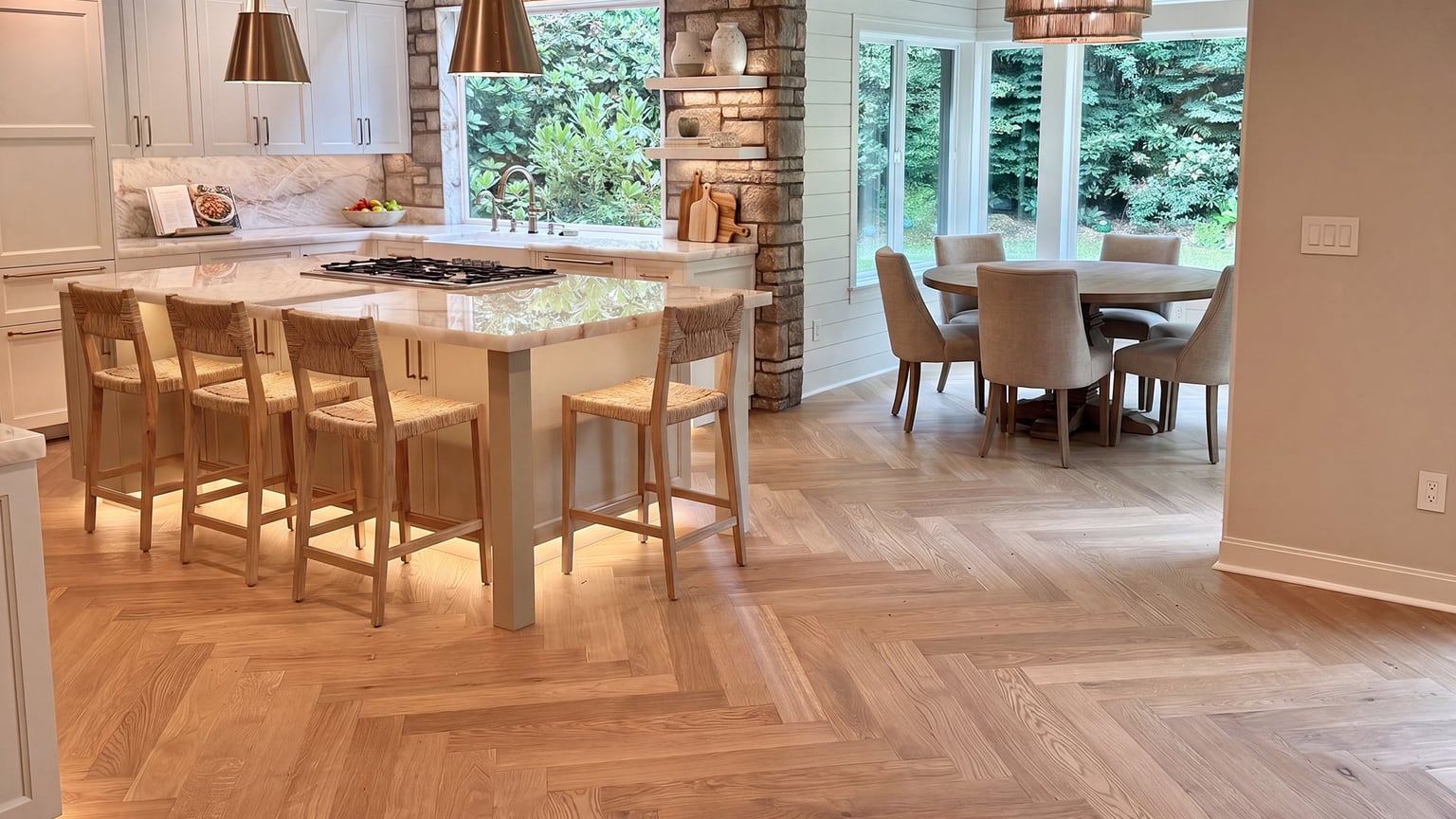
Herringbone suits a dining room, because the pattern shows around the edges of the table and under the chairs. The photograph at the top of this page is Monarch Plank Domaine II - Herringbone Montrichard, running through a kitchen and dining room.
A herringbone layout is set before the first piece goes down, usually from a centre line in the room. Where that line falls is worth deciding at measurement, with the position of the table in mind.
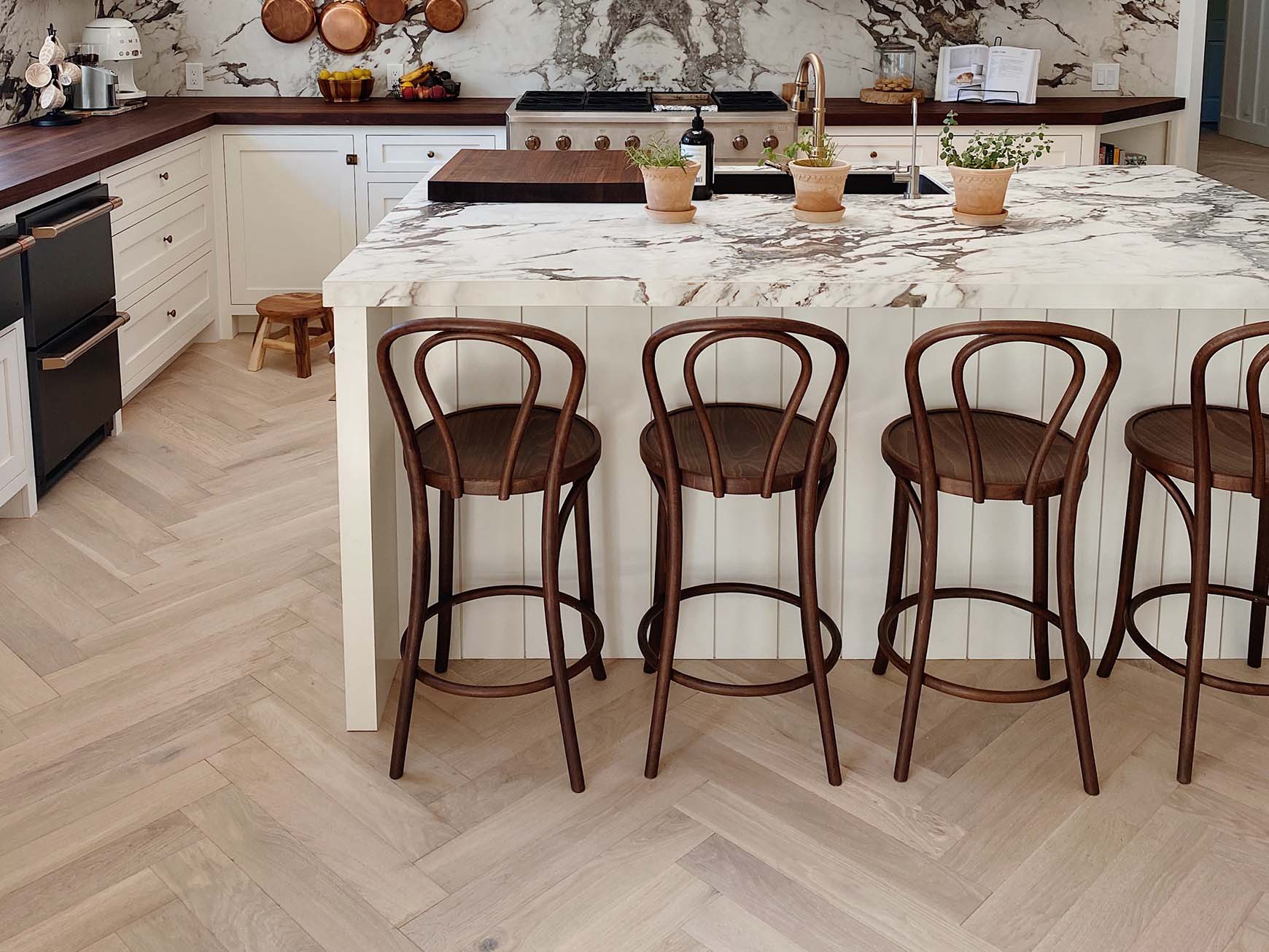
Many dining rooms open onto a kitchen. Running one floor through both avoids a threshold under the chairs and keeps the space reading as one room. In the kitchen below, pale oak herringbone runs around a marble island, and the bentwood stools will drag across it just as dining chairs do.
A rug under the table protects the floor, but only if it is large enough. When a chair is pulled out to sit down, all of its legs should still be on the rug. Otherwise the back legs catch on the edge and wear a line in the floor beside it.
Plan for renewal from the start
Even a well-chosen dining room floor will eventually show a worn path where the chairs move. What you can do about it depends on the sawn top layer, the solid oak that sits above the backing.
Monarch Plank Domaine II Retz has a 6 mm top layer. Monarch Plank Lago Bolsena has a 3 mm top layer. A thicker top layer leaves more oak to sand back if the floor ever needs a full refinish.
Many worn dining floors never need that. A screen and recoat, where the old finish is lightly abraded and a fresh coat goes on, can renew a scratched surface without sanding into the wood. Ask whether the factory finish accepts a recoat, and follow the manufacturer's care instructions.
What we would ask before recommending a floor
Before suggesting a floor for a dining room, we want to understand how the room is really used.
- How often is the table used, and by whom?
- Is the dining room open to the kitchen, and should the floor continue through?
- What chairs do you have, and do they already have pads or glides?
- Will a rug go under the table?
- How much visible wear can you live with before it bothers you?
You can order samples of the floors on your shortlist and try them at home. Put a sample under one of your own dining chairs and slide the chair back and forth a few times, then look at it from standing height.
Common questions about dining room floors
Is hardwood a good choice for a dining room?
Yes, for many homes. Engineered oak with a low-sheen finish handles chair traffic well, provided the chairs have pads and spills are wiped up promptly. Homes with heavy daily spills may be happier with a waterproof floor.
Should the dining room floor match the kitchen?
If the rooms are open to each other, one floor through both usually looks calmer and avoids a threshold. If they are separate rooms, a change of floor at the doorway is perfectly reasonable.
Does herringbone work in a dining room?
It does, and the pattern reads well around a table. Settle the centre line of the pattern with the table's position in mind, because it cannot be moved once the floor is down.
Do I need a rug under the dining table?
Not necessarily. A rug only protects the floor if the chairs stay on it when pulled out. A rug that is too small can leave a worn line along its edge instead.
How do I protect a wood floor from dining chairs?
Fit felt pads or wide glides to every leg, check them often, and keep grit off the floor. Those habits protect the surface more than any finish can on its own.
Choosing a floor for the table you have
A dining room asks for a floor that forgives chairs, spills and crumbs, and one that can be renewed when it finally shows its use. Compare textured and character-grade oaks in the full flooring range. When you have a shortlist, request a quote with a free in-home laser measurement.