
European Oak vs Vinyl Flooring: What Differs
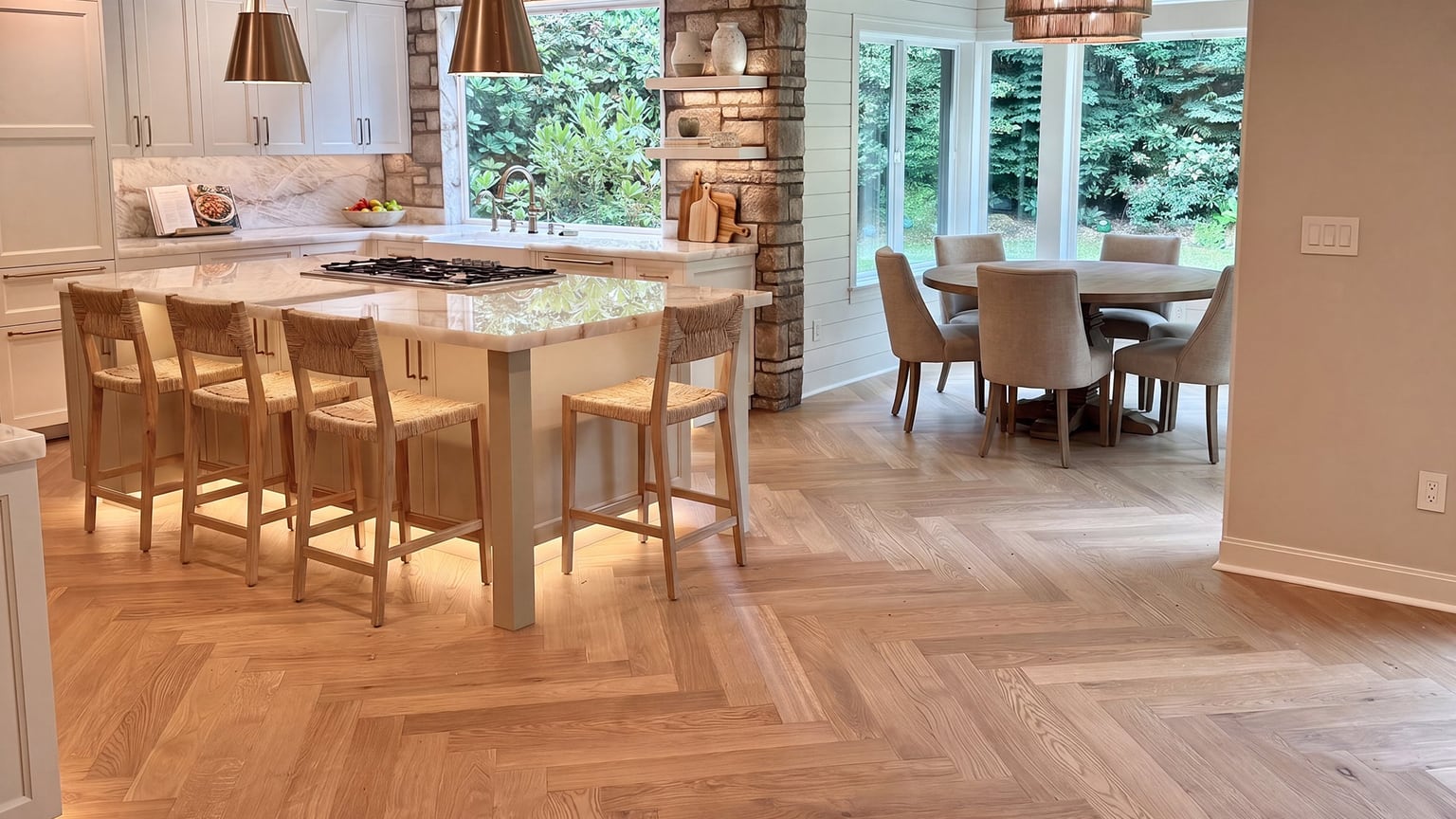
The short answer on European oak vs vinyl flooring: oak is real wood that can be sanded and renewed, and it does not want standing water. Vinyl is a sealed, printed surface that shrugs off spills but cannot be refinished once it wears through. Choose oak for the rooms you plan to live with for a long time, and vinyl where water is a daily event.
Everything else follows from those two facts: the look, the feel underfoot, the sound, and what the floor looks like after a dog has lived on it. This piece walks through each difference and what to check in your own home before you choose.
What each floor is actually made of
The European oak floors we supply are engineered. A layer of solid oak sits on top of a core, and the catalogue lists that core as hardwood lumber on some collections and hardwood plywood on others. The oak you see and touch is the same wood you would find in a solid board.
Vinyl plank and vinyl tile are a different kind of object. Each is a stack of bonded layers: a core, a printed image of wood or stone, and a clear wear layer over the print. What looks like grain is a photograph, and the texture is pressed in to line up with it.
That single difference drives most of the others. Oak is a material that ages and can be renewed. Vinyl is a surface that holds its look until the top layer is worn, and then it is finished.
The wear layer is the difference that matters most
On oak, the wear layer is the thickness of real wood above the core. The Monarch Plank Domaine II Retz carries a 6 mm top layer. The Monarch Plank Tableau Renoir carries 4 mm, and the Monarch Plank Lago Belviso carries 3 mm.
That thickness is what a floor refinisher sands through. A thicker oak layer can be sanded back to fresh wood and refinished more than once. That is how a scratched, sun-faded oak floor becomes a new floor again without being torn out.
On vinyl, the wear layer is a clear coating over the printed image. It cannot be sanded, because there is nothing underneath it but the print. When it wears through in a doorway or in front of the sink, the repair is a replacement plank, not a refinish.
So the question is not which floor is tougher on day one. It is how long you intend to keep the floor, and whether you want the option of renewing it rather than replacing it.
Water, kitchens and bathrooms: where vinyl earns its place
Here is the trade-off stated plainly. None of the European oak floors in this comparison is waterproof, and the catalogue lists each of them that way. A leaking dishwasher, or a toilet supply line that weeps overnight, can cup and stain an oak floor.
A vinyl plank with waterproof construction handles that far better. Water sitting on the surface does not swell it, and a wet mop is not a risk. That makes vinyl a sensible floor for a full bathroom, a laundry room, or a mudroom where boots come in wet.
Oak can still work in a kitchen if you wipe spills up promptly and accept that the floor will mark over time. What we would not do is put wood into a bathroom with a shower, whatever the finish. That is a room where vinyl is simply the right material.
How each one looks and feels underfoot
Oak grain does not repeat. Every board has its own figure, knots and tone, and a rustic grade shows that variation openly. The Monarch Plank Tableau Renoir is a rustic grade with a wire brushed texture, and the photograph below shows how much one board can differ from the next.
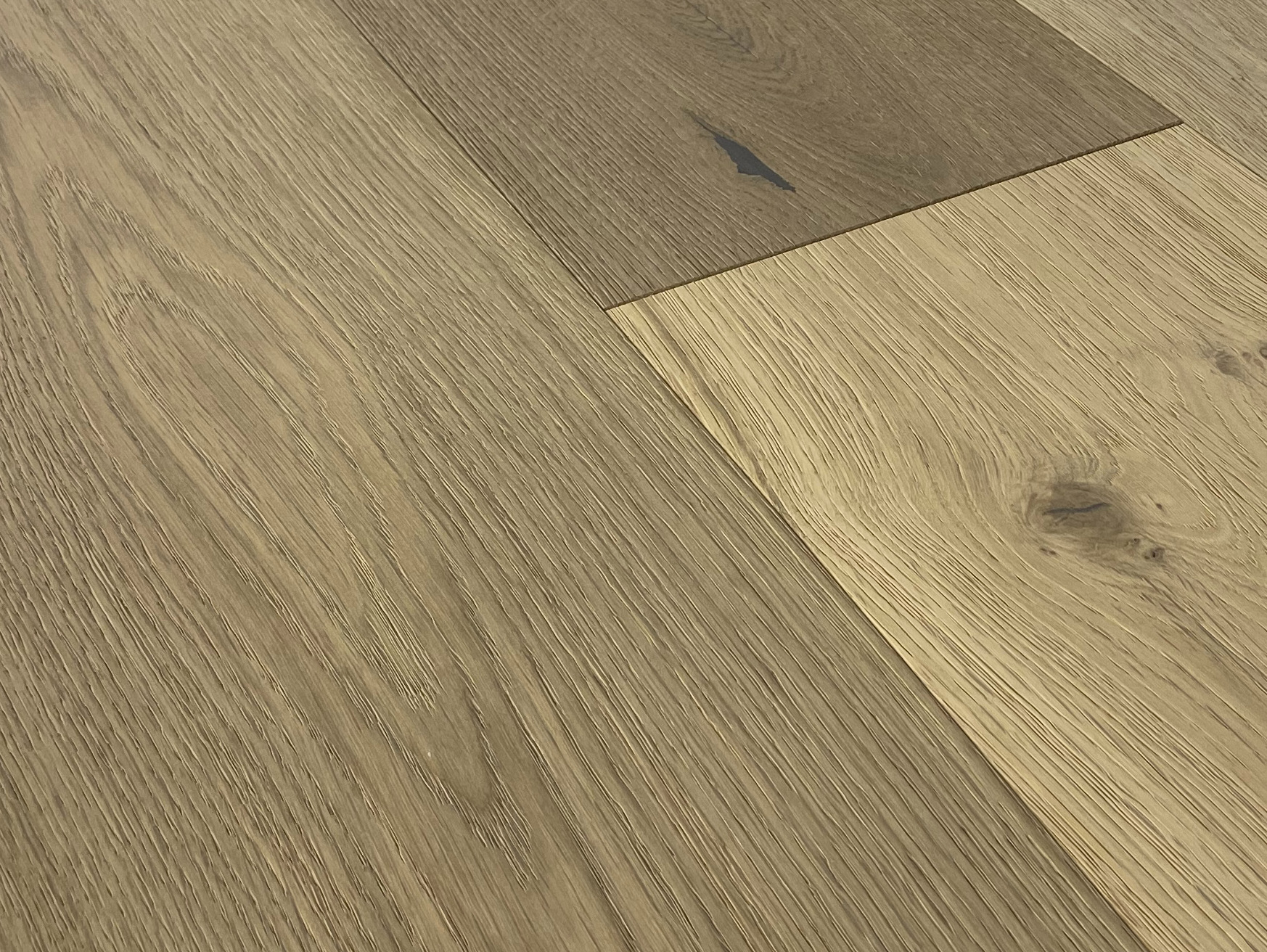
Vinyl reproduces grain with a printed image. A good print is convincing at standing height, but a repeat in the pattern can show across a large room, and every board carries the same sheen. Under raking light from a low window, the difference is easy to see.
Underfoot, oak feels firmer and sounds like wood when you walk on it. Vinyl is softer and quieter over a good underlayment, and it can sound hollow when it floats over an uneven subfloor. Neither is wrong, but you will notice the difference every day.
If you want to see the oak side of this comparison properly, look at the Monarch Plank Tableau Renoir product page, where the specifications sit beside the photographs.
Texture, finish and how each one hides wear
The Monarch Plank Lago Belviso has a wire-brushed texture and a UV Urethane, Ultra-Matte finish. Wire brushing opens the grain so the surface has a slight tooth. That texture, with a matte sheen, is what makes oak forgiving of small scratches, because a mark has somewhere to hide.
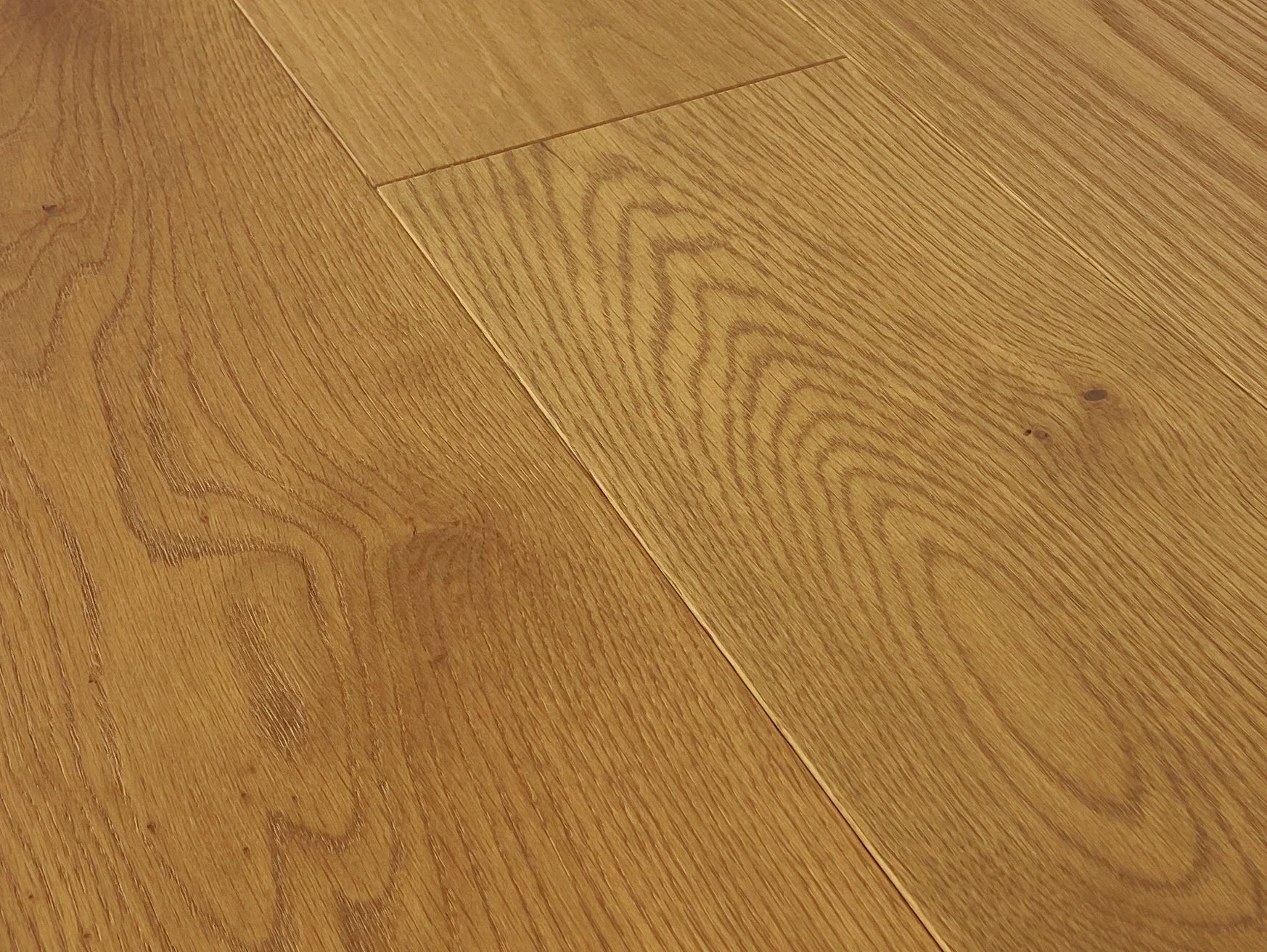
Smooth oak shows more. The Monarch Plank Domaine II Retz has a smooth texture, which reads calm and clean in a quiet living room, but a scratch catches the light. If you have dogs or children, texture matters more than colour, and you can compare it on the Monarch Plank Domaine II Retz page.
Vinyl hides scratches differently. A scuff in the clear wear layer turns dull or pale rather than exposing new colour, and it cannot be sanded out. Once a vinyl floor looks tired in the traffic lanes, it stays that way.
If claws are the main worry, our article on flooring for dogs, claws and water bowls covers the pet side in more depth.
Width, pattern and scale in the room
Oak gives you a wide spread of plank widths. The Monarch Plank La Grande Parsenn is 11-3/8" wide, the Monarch Plank Tableau Degas is 8-5/8", and the Monarch Plank Dover Citadel is 7-1/2". A wider board reads calmer and shows more of each tree, while a narrower board suits a smaller room.
Herringbone is the other place oak stands apart. The Monarch Plank Domaine II - Herringbone Montrichard is a hand scraped herringbone at 4-3/4" wide with a 6 mm top layer. Herringbone takes more labour than straight planks, because every board is cut and fitted to its neighbours.
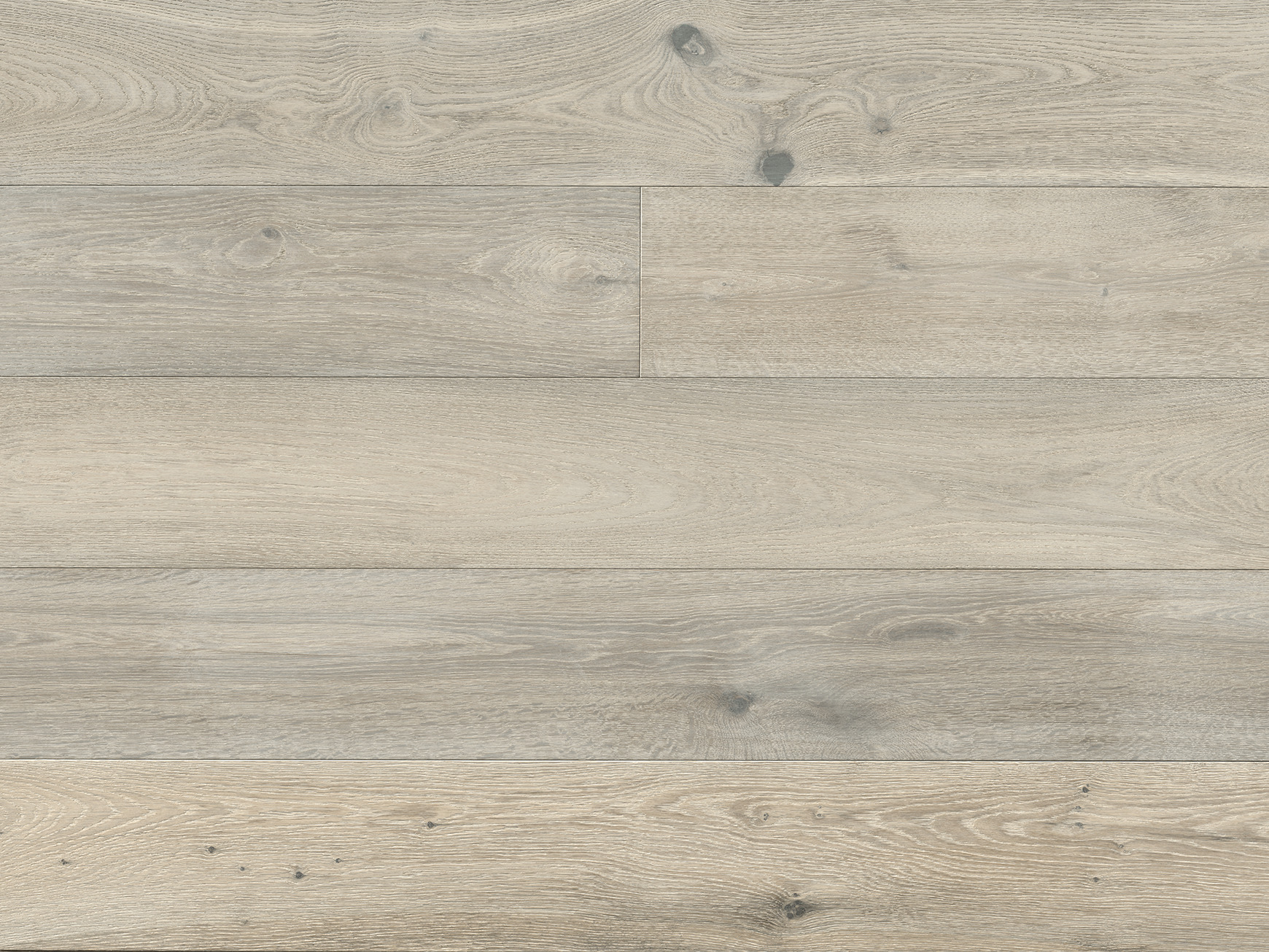
When you plan a rustic oak floor, look at a spread of boards together, not a single piece. Knots and board-to-board variation read very differently across a floor than they do in your hand. The Monarch Plank Tableau Cezanne, laid out flat, shows the effect.
What to check in your own home before you choose
Start with water. Walk the house and note every room where water is a regular event: a bathroom with a shower, the laundry, the entry from the garage. Those are vinyl rooms, and the rest of the house can reasonably be oak.
Then look at the subfloor. Both floors need a flat, dry, sound base, but a thin vinyl plank shows every dip and ridge through its surface. A thick engineered oak plank is more tolerant, though neither floor forgives a subfloor that moves.
Then plan for acclimation. Engineered oak needs time in the room before it goes down, and the conditions in the house matter. Follow the manufacturer's installation instructions rather than a rule of thumb, for either material.
Finally, be honest about how long you will live with the floor. If you plan to stay, a thick oak top layer can be renewed more than once. If the floor has to survive a hard stretch of rentals, pets or teenagers and then be replaced, vinyl is the practical choice.
What we would ask before recommending either
Before we recommend a floor, we ask which rooms get wet, what sits under the current floor, and who walks on it. We also ask whether the rooms connect, because a change of material in an open plan needs a transition you will see every day.
The answers usually split the house rather than choose one floor for all of it. Oak in the living room, dining room and bedrooms, with vinyl in the bathrooms and laundry, is a common and sensible result.
You can request a quote and book a free in-home laser measurement, which records the room sizes and lets someone look at the subfloor. When the quote is ready, you can pay after measurement, or pay now by card.
Common questions about European oak and vinyl
Is European oak the same as American white oak?
They are different species with a similar look. The oak in the collections named here is listed in the catalogue as European Oak, so that is the species you would be getting.
Can an engineered oak floor be refinished?
Yes, when the top layer is thick enough. A 6 mm layer, like the one on the Monarch Plank Domaine II Allier, gives a refinisher the most to work with. The Monarch Plank Lago Moro has a 3 mm layer, which allows less sanding over its life.
Can vinyl run through a kitchen that opens onto the living room?
It can, and it is a reasonable choice where spills are frequent. The trade-off is either a change of material where the kitchen meets the living room, or vinyl through the whole space.
Which is the safer choice with dogs?
Textured oak hides claw marks well, and deeper scratches can be sanded out later. Vinyl copes with the water bowl far better. Oak in the living spaces and vinyl by the back door is a common split.
Does oak cost more than vinyl to install?
The installed cost depends as much on the subfloor, the pattern and the room as on the material. Herringbone takes more labour than straight planks. Published prices for each floor sit on its product page.
Where to start
Order samples of the oak you are considering and set them on the floor of the actual room, in the light you live with. Then see the range of flooring, where each European oak plank lists its wear layer, width, texture and construction, so you can match the floor to the room before anyone comes to your house.