
Flooring for dogs: what claws and water bowls do
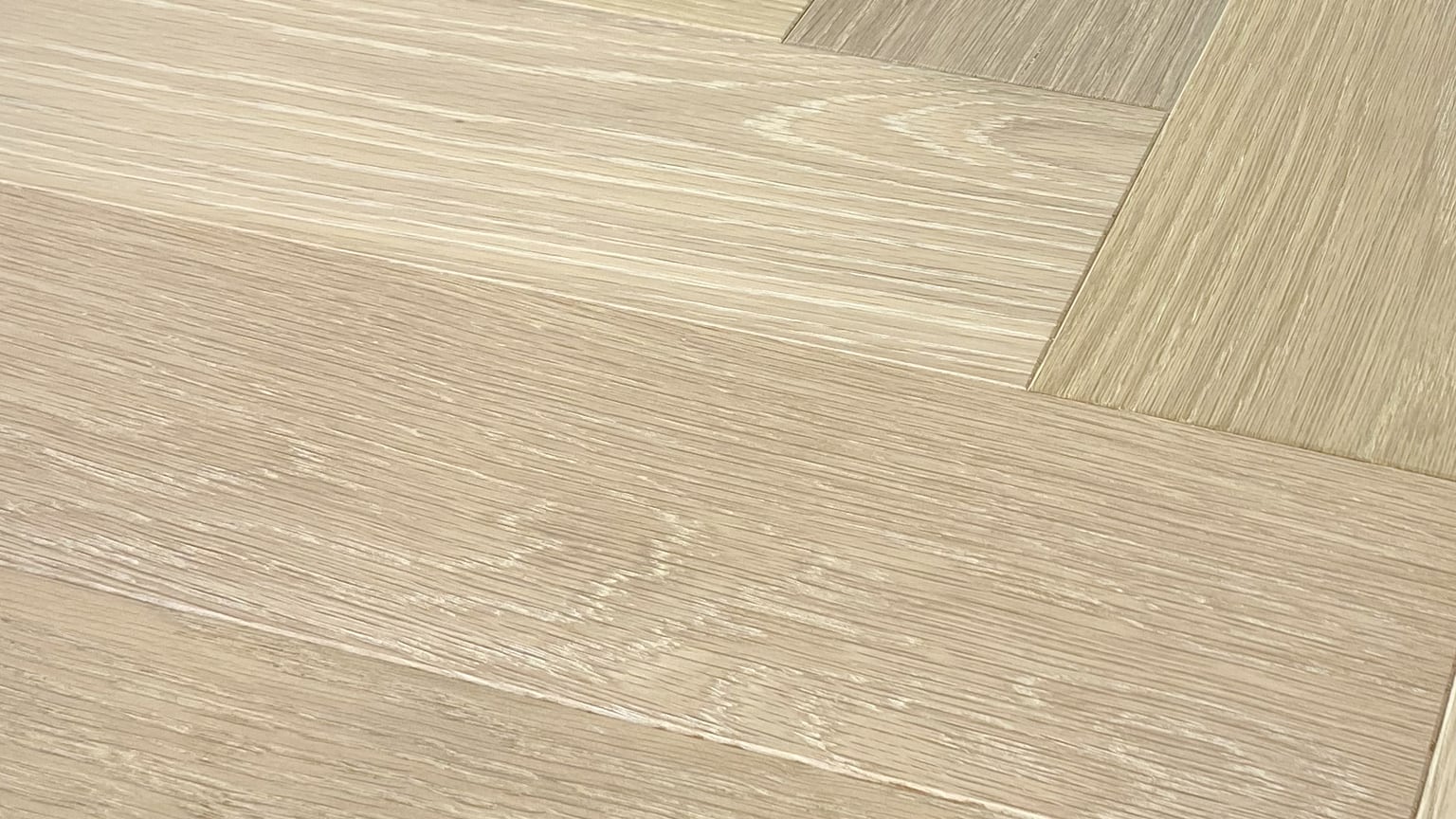
Good flooring for dogs has two separate jobs, and no single spec does both. Claws scratch the surface, so what matters is how thick the real wood top layer is and how well the finish disguises marks. A water bowl is standing water, and none of the engineered oak floors below has waterproof construction, so the bowl needs a plan of its own.
This piece reads the spec sheet the way we would before recommending a floor for a house with a dog. It covers what claws actually damage, which numbers change the outcome, and where the bowl should sit.
What claws actually do to a wood floor
Everyday claw marks rarely reach the wood. They sit in the finish, the clear coat on top, and show as fine pale lines where light catches the scuffed surface. Deeper gouges come from a dog skidding on a turn, landing off the sofa, or grinding in grit carried from the yard.
No wood floor is scratch-proof. Oak will mark, and a floor sold as scratch-proof is describing its finish on the first day, not the floor over its life. The useful questions are how much the marks show and what you can do about them later.
Every floor named in this article carries the same finish: UV Urethane, Ultra-Matte. That takes finish type out of the comparison. It leaves the two things that genuinely differ between them, which are the thickness of the top layer and the look of the wood.
Why top layer thickness decides the long run
Engineered wood is a layer of real sawn oak bonded to a backing. The top layer is the part you walk on. It is also the only part that can be sanded back to fresh wood when claw marks go deeper than the finish.
That makes its thickness the spec that tells you how many second chances a floor has. Monarch Plank Manor Winslow, Monarch Plank Manor Aldin and Monarch Plank Domaine II Retz each list a 6 mm sawn top layer on hardwood lumber backing. Monarch Plank Tableau Renoir, Monarch Plank Dover Walmer and Monarch Plank Premio Cielo list 4 mm, and Monarch Plank Lago Bolsena lists 3 mm.
With a dog, the difference is margin. A floor with a 6 mm layer can be sanded and refinished more times over its life than one with 3 mm. How many times depends on the sanding, the flatness of the subfloor and the person doing the work, so read it as margin rather than a count.
Match the margin to the dog. A young, large or fast dog in its favourite rooms argues for the thicker layer. An older, calm dog makes a thinner layer a fair trade for a pattern or plank width you prefer.
How the look of the wood hides or shows marks
Scratches in a clear finish usually read as pale lines. On a dark, even floor they stand out, while on a floor with visible grain and colour variation they tend to disappear. Knots, filled pinholes and tone shifts between boards give the eye something to read other than a scratch.
The ultra-matte sheen helps for a related reason. A glossy finish reflects light as one clean sheet, so any break in it shows. A matte surface already scatters light, so a light scuff changes what you see far less.
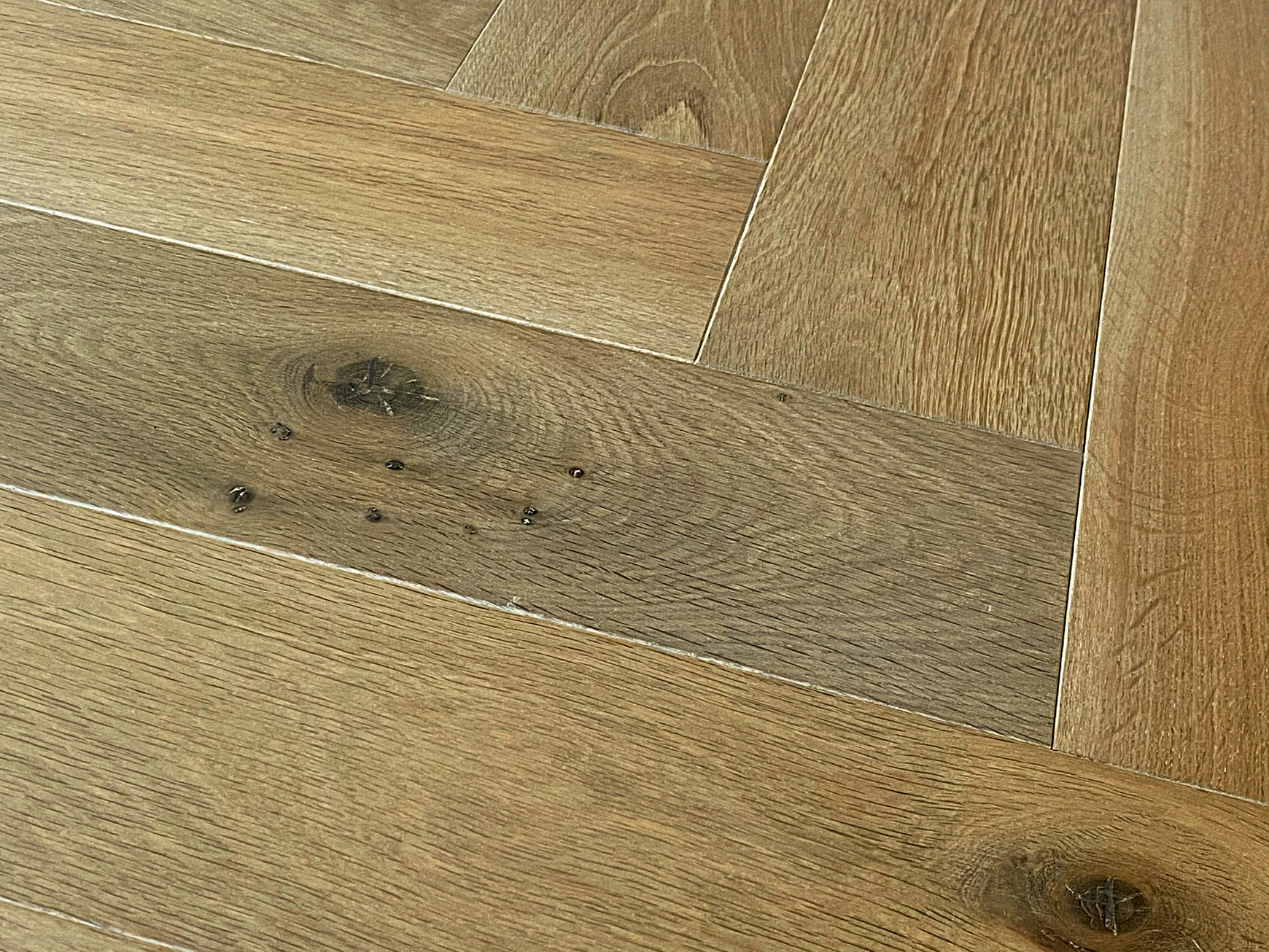
In the close-up of Monarch Plank Domaine II - Herringbone Verte below, a large knot and dark filled pinholes break up the warm brown surface. The bevelled joints between pieces add small shadows of their own. That kind of character absorbs everyday wear visually.
A pale, plain floor sits between the two. Monarch Plank La Grande Thyon photographs as pale and low in contrast. Pale scratch lines blend into a floor like that, but dark grit and paw prints show between cleans.
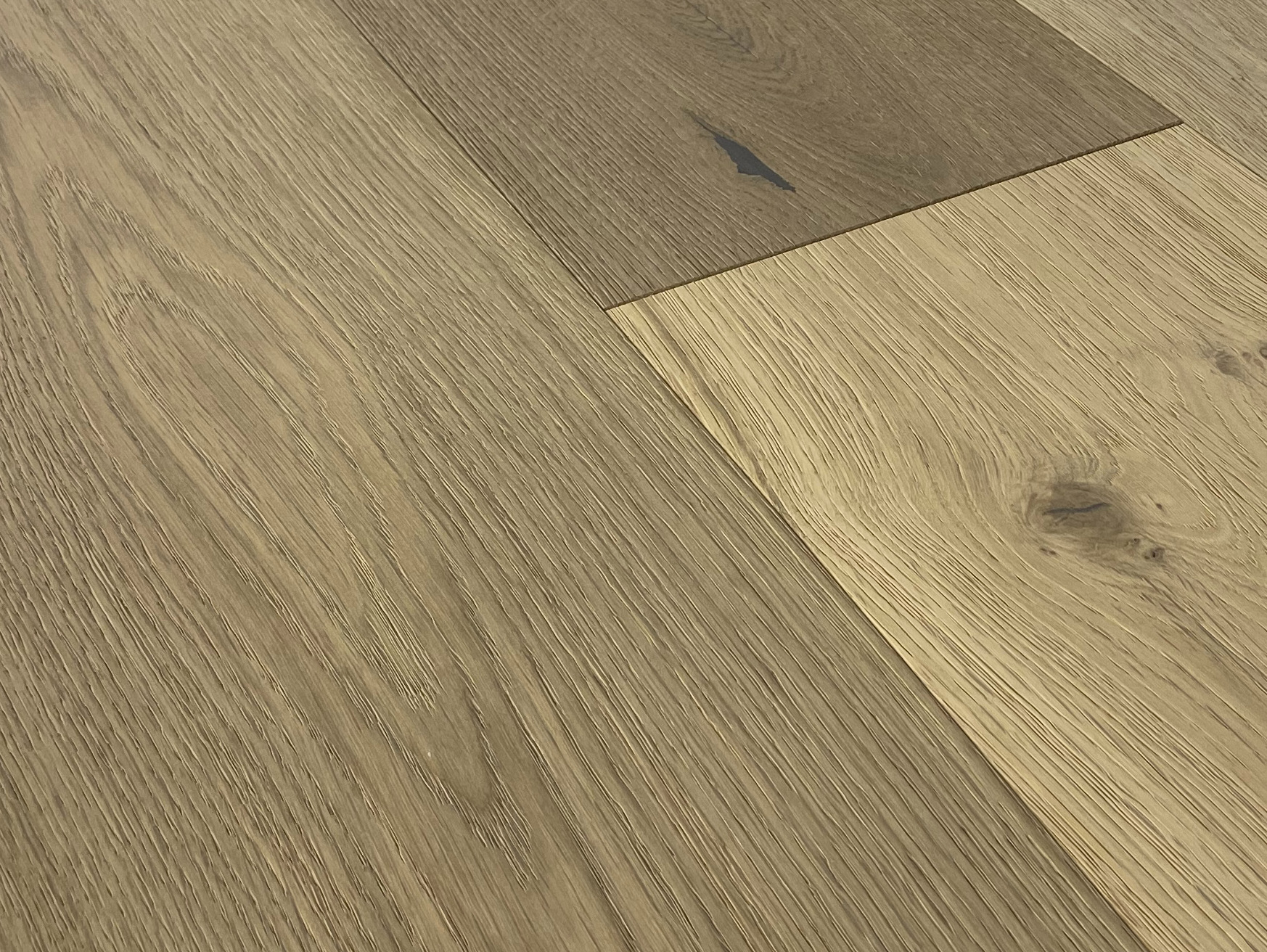
Texture is the other half of the look. When the grain stands slightly proud of the softer wood around it, scuffs fall into its shadows. Monarch Plank Tableau Renoir, in the close-up below, pairs deep grain with a dark filled knot, an end joint, and a light board beside a darker one.
A water bowl is a different problem
None of the floors in this article is waterproof. Each is engineered oak on a hardwood plywood or hardwood lumber backing, and wood takes up water at its edges and joints. A bowl that gets tipped, splashed or dripped on every day puts water right where wood is vulnerable.
The damage is slow and quiet. Water collects under the bowl, finds a seam and swells the edges of the boards, which then cup or lift. By the time the change is visible, the patch has usually been wet for a long while.
Herringbone adds a detail worth knowing. The pattern is built from short pieces, so a small patch of floor carries far more seams than wide plank does. Monarch Plank Domaine II - Herringbone Montrichard is 4-3/4" wide, while Monarch Plank Manor Winslow is 9-1/2" wide, and the bowl sees the difference.
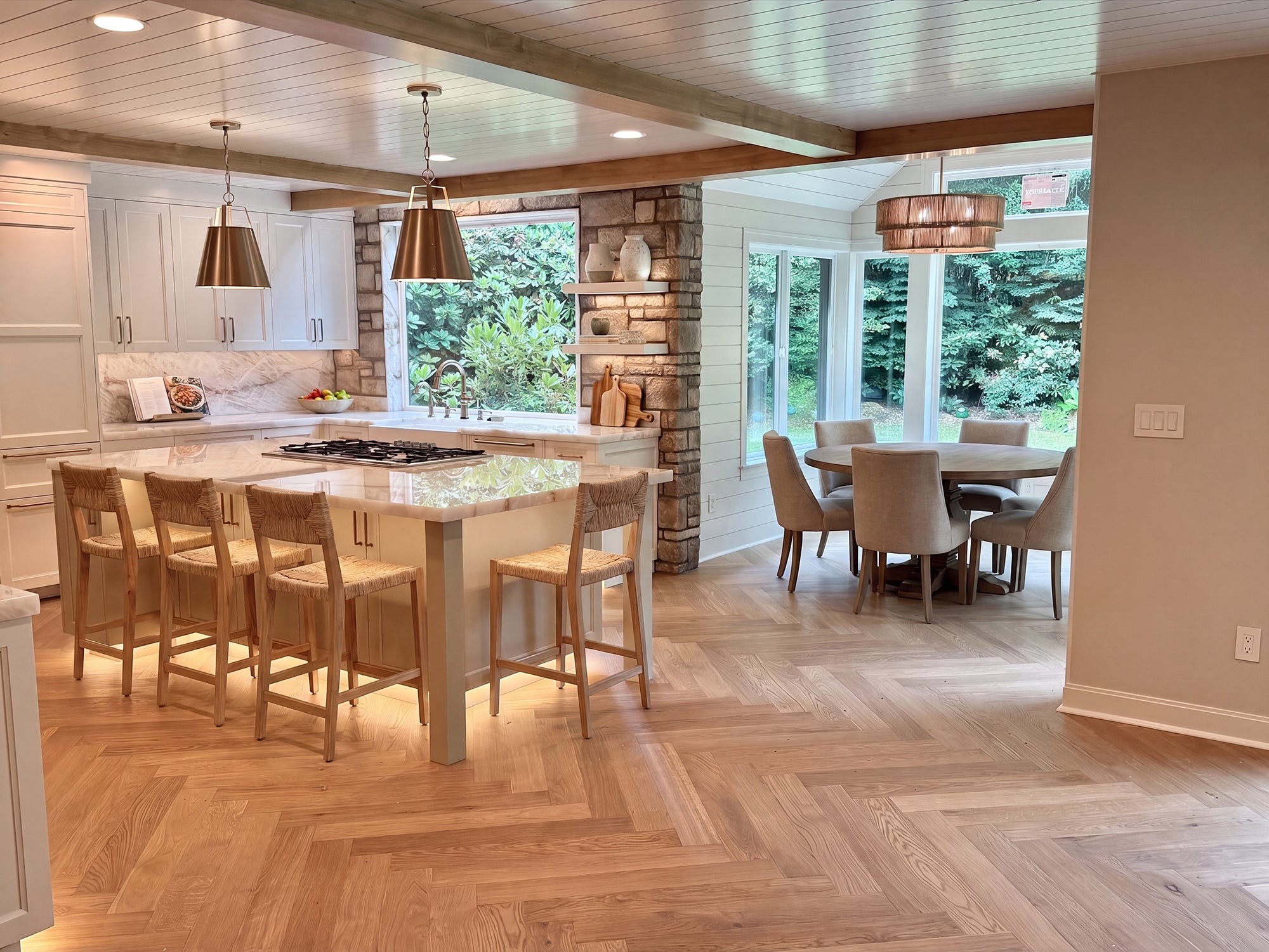
Kitchens are where bowls usually end up, and a herringbone kitchen puts many of those seams within reach of a splash. The photograph below shows Monarch Plank Domaine II - Herringbone Montrichard laid through a kitchen and dining room.
Where the bowl should go and what goes under it
The simplest fix involves no flooring decision at all: move the bowl. A laundry room, mudroom or utility space with a floor of waterproof construction can hold it, and the oak stays in rooms where the dog walks rather than drinks.
If the bowl stays in the kitchen, set it on a mat with a raised lip and a waterproof base, not a fabric rug. Lift the mat and dry underneath it regularly. A damp mat left in place traps water against the wood, which is worse than no mat.
Wipe splashes when they happen, and keep the finish in good repair. A worn finish lets water reach bare wood sooner, and that is how a routine splash turns into a swollen seam.
Some households choose a different material for the whole kitchen for this reason. That is a sound call, and it is easier to make before the oak is ordered than after. You can compare oak with other materials across the full flooring range before you decide.
What to check in your own home first
Watch where your dog actually goes for a while before you choose. Wear gathers along a few paths: the route to the door, the turn at the foot of the stairs, the launch spot by the sofa, and the patch in front of the bowl.
Check the entry. Grit is what turns ordinary claw contact into deep scratches, so a sturdy doormat outside and a washable runner inside do real work. Keep nails trimmed, because a dog you can hear clicking across the floor is a dog marking it.
Check what is under the floor. A kitchen over a crawl space behaves differently from one on a slab when a wet patch sits on top, and the installer should know before layout begins. Follow the manufacturer's installation instructions for acclimation rather than a rule of thumb.
Then order samples of the floors you are weighing and live with them for a while. Put them where the dog walks, drag a key across a corner, splash one, and look at them in your own light.
How the named floors line up for a dog household
If refinishing margin matters to you, start with Monarch Plank Manor Winslow. It is European Oak with a 6 mm top layer, 9-1/2" wide and 3/4" thick. Monarch Plank La Grande Thyon lists the same 6 mm layer at 11-3/8" wide, so a room needs fewer seams.
If you want herringbone with the thicker layer, look at Monarch Plank Domaine II - Herringbone Verte, which lists a 6 mm top layer at 4-3/4" wide. Monarch Plank Lago - Herringbone Como and Monarch Plank Lago - Herringbone Devero are 4-3/8" wide with a 3 mm top layer. That suits a calm dog better than a young one.
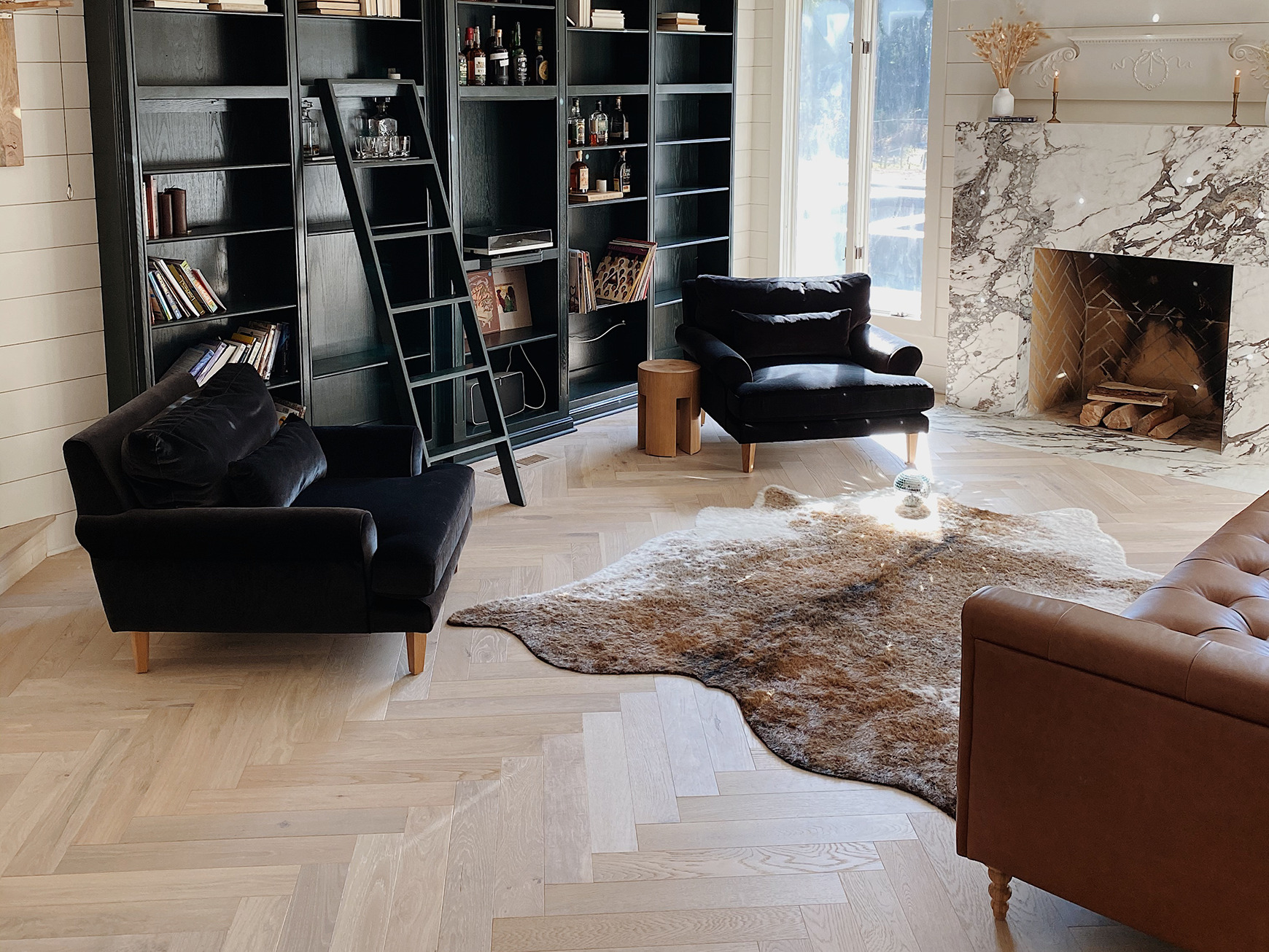
Monarch Plank Lago - Herringbone Devero, shown below in a living room, is a pale oak herringbone. A pale, varied surface like this one keeps light scratch lines quiet, which helps offset the thinner layer.
In the middle sits Monarch Plank Dover Walmer, with a 4 mm top layer at 7-1/2" wide and 25/32" thick. Monarch Plank Premio Cielo is Red Oak with a 4 mm top layer at 7-1/2" wide, if you prefer the look of red oak.
Common questions about flooring for dogs
Is engineered oak a poor choice for a house with a dog?
No, but it comes with known limits. Oak scratches in the finish and should be kept away from standing water. A thicker top layer and a varied, textured surface make those limits easier to live with.
Does an ultra-matte finish stop scratches?
It does not stop them. It makes light scuffs harder to see, because a low sheen has no mirror-like surface for a scratch to interrupt. Deep gouges still show and still need repair.
Can a scratched engineered floor be repaired?
Marks confined to the finish can often be handled with a maintenance recoat. Scratches that reach the wood need sanding, and the top layer decides how much sanding the floor can take. Have the damage looked at before choosing the repair.
Will a water bowl ruin a wood floor?
Not if the water never sits on it. A waterproof mat with a lip, lifted and dried regularly, protects the boards underneath. A bowl placed straight on oak and splashed daily will eventually swell the seams under it.
Is herringbone harder to live with than plank flooring?
For scratches, the difference is small. For water, herringbone packs more seams into the same patch of floor, so the bowl area needs more care. You can keep the herringbone and move the bowl.
Do you measure and install these floors?
Yes. Every project starts with a free in-home laser measurement. Delivery and professional installation available across our service area are carried out by licensed, insured, background-checked local installation partners, and the service areas page lists where we work.
What we would ask before recommending a floor
Before we suggest a floor for a house with a dog, we ask a few plain questions. How big is the dog, and does it run or wander? Where does it eat and drink, and can the bowl move?
We also ask which rooms the dog uses, what sits under the floor, and whether you would rather refinish one day or never sand at all. The answers usually point to a top layer thickness and a look before they point to a product.
A useful next step is to have the rooms measured and the bowl zone looked at in person. Request a quote and we will begin with a free in-home laser measurement of the rooms your dog uses.