
Hickory flooring: what the spec sheet actually means
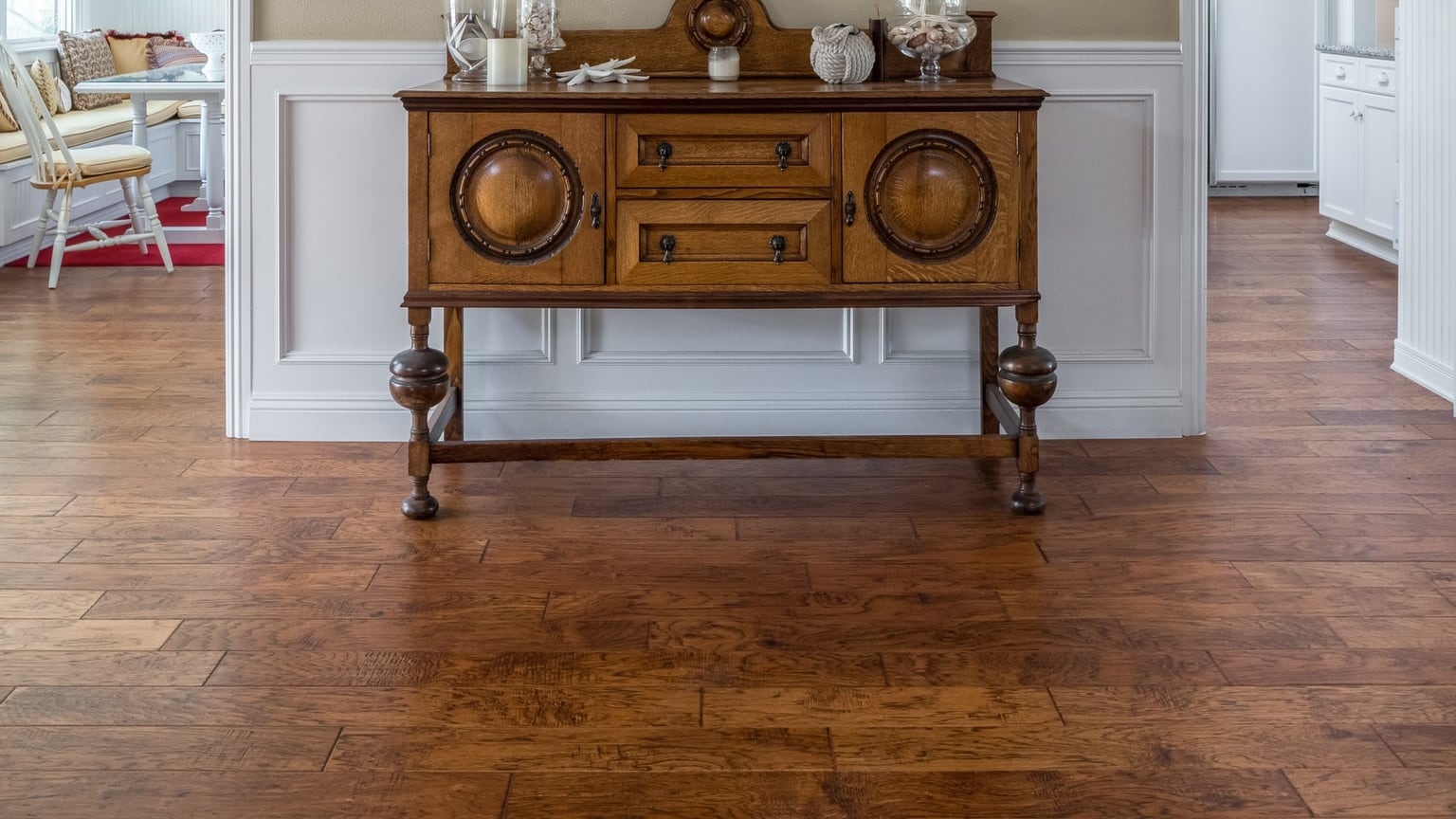
On a spec sheet, hickory flooring means one thing: the layer you walk on is cut from hickory, a hard, pale North American wood with strong colour variation between boards. It does not tell you the colour, the texture, the sheen or how many times the floor can be sanded. Those come from other lines on the same sheet, and the species line only sets the limits they work within. If you are choosing hickory because you want a hard floor with visible character, the species delivers that. Whether it is the right floor for your room depends on the grade, the wear layer and the finish, which is what the rest of this article walks through.
Hickory is a species line, and it decides three things
Species is the line that fixes the raw material. For hickory, that brings three properties that no finish or texture can undo.
First, hardness. Garrison lists a Janka hardness of 1820 for Garrison Carolina Classic Salem, the floor in the photograph at the top of this page. The same figure appears on the other Garrison hickory floors in our range. Janka measures how much force it takes to press a steel ball halfway into the wood, so a higher number means a surface that dents less under a dropped pan. Hickory sits above the oaks on that scale, which is why it is the species people ask for when a floor has to survive dogs, kids and a hallway that connects everything.
Second, colour variation. Hickory heartwood is reddish brown and its sapwood is nearly white, and a single plank can carry both. A floor of natural hickory looks striped and lively, not uniform. Stain narrows the gap but never closes it, and a dark stain can leave pale sapwood reading as a lighter streak through a brown board.
Third, movement. Hickory is a dense wood that takes on and gives up moisture with the seasons, and it shows that as small gaps in the dry months and tight joints in the damp ones. Engineered construction, where a hickory layer is bonded to plywood, tames most of this. Solid hickory does not get that help, which matters for how it is installed and where.
Grade: Select Character, Character, Rustic and Mill Run
Grade is the line most homeowners skip, and with hickory it is the one that decides how the floor looks. Grade describes how much natural character the mill allowed into the boards: knots, mineral streaks, and the swing from sapwood to heartwood.
Garrison labels most of its hickory Select Character, a grade that admits the species' colour swing and some knotting without the largest defects. Garrison Carolina Classic Beaufort carries that grade and shows what it looks like in the natural colour: cream boards next to tan boards, all from the same box.
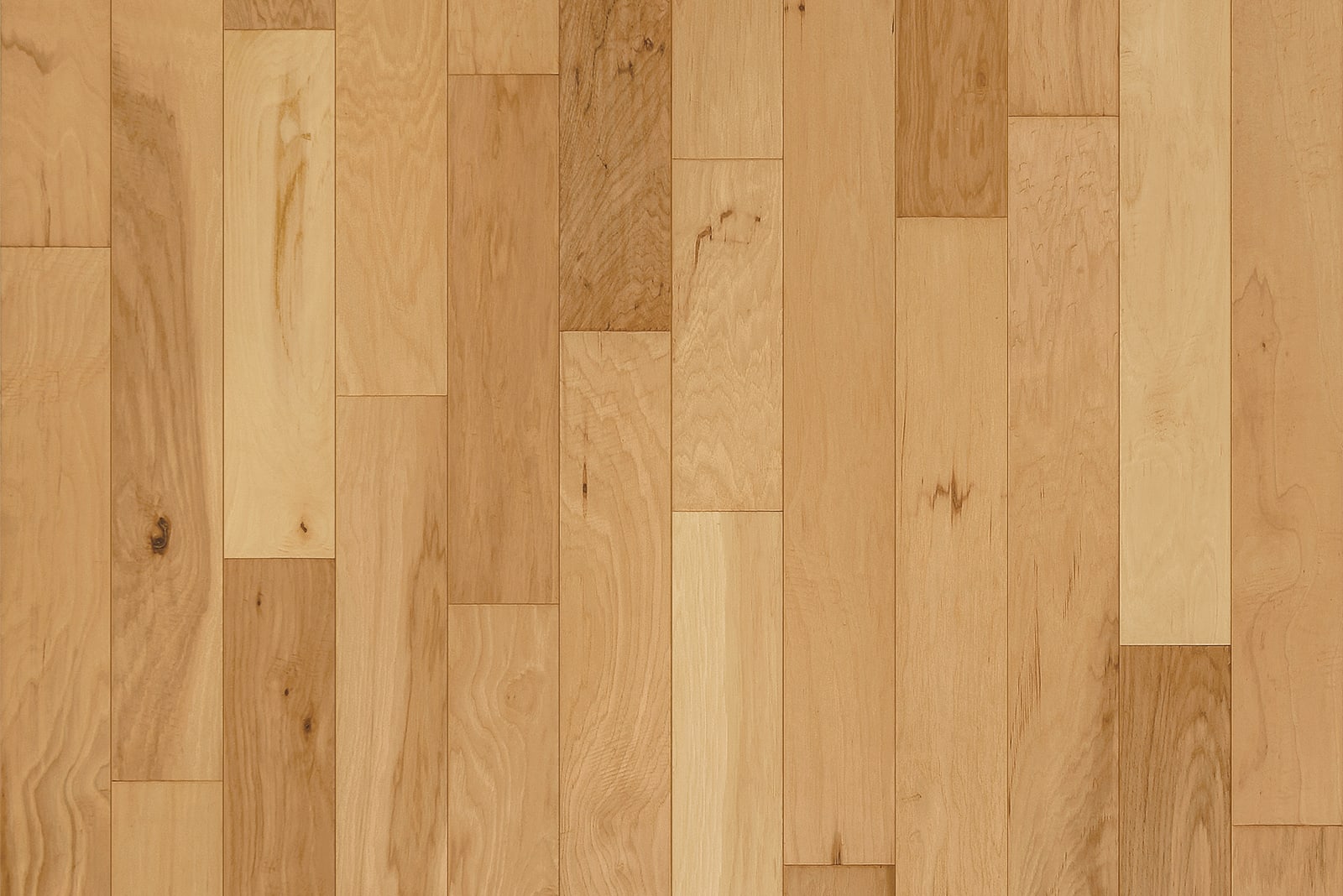
Reward uses Character for its EL PASO floors such as Reward EL PASO Hickory Natural, and Rustic for Reward CAMINO II Hickory Natural and Reward AVALON Hickory Kay. Rustic admits more knots and more colour range than Character. In the natural colour, the Rustic grade is where hickory's blond and brown boards sit side by side with nothing to soften the contrast.
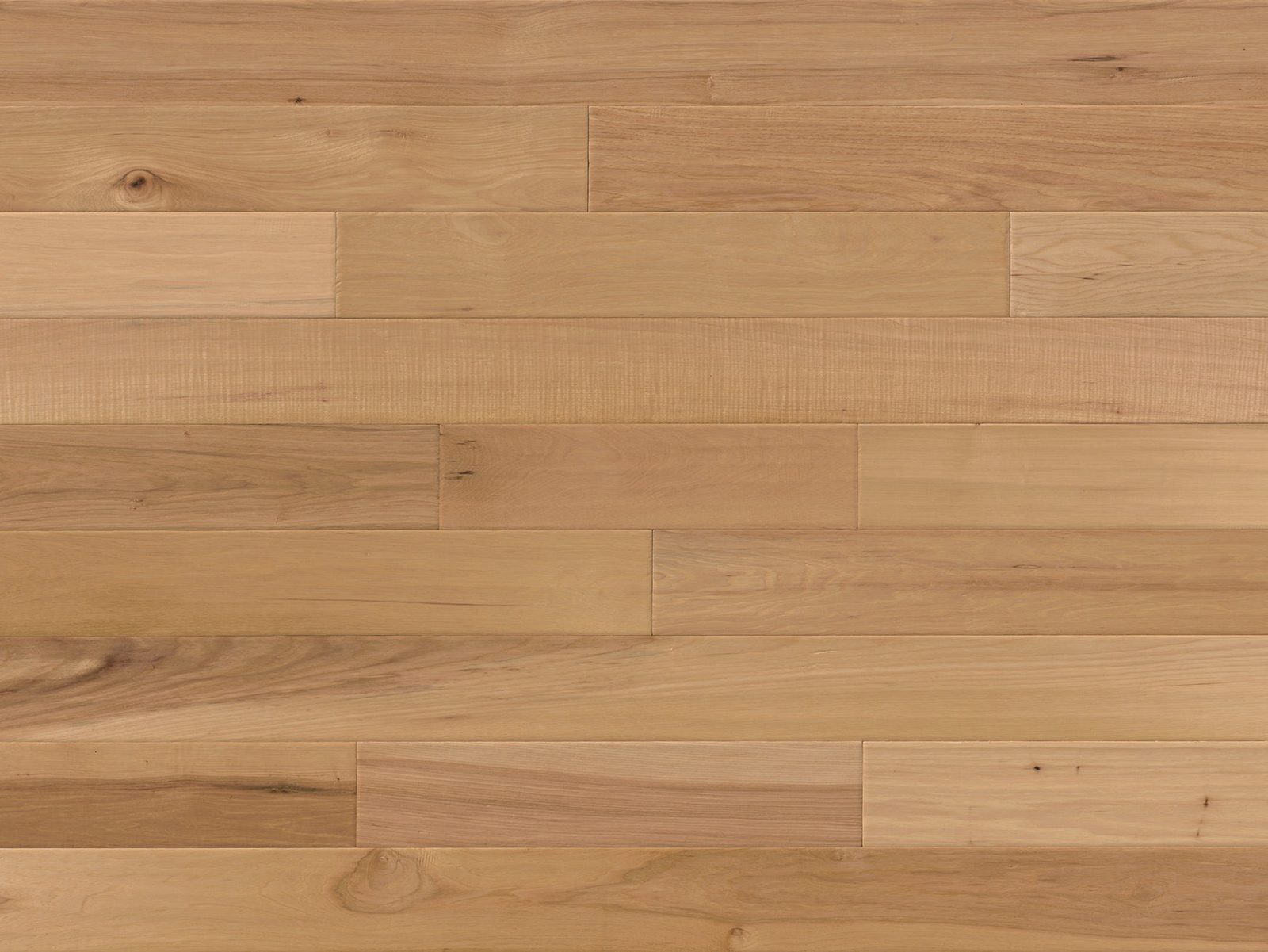
Garrison Competition Buster Hickory Vintage is graded Mill Run, which means the boards were not sorted for character at all, so you get whatever the log produced. What this means for your room: a Rustic or Mill Run hickory in a natural colour is a busy floor. In a large open room with plain walls it reads as warmth. In a small bedroom with patterned textiles it can read as noise. If you want hickory's hardness without the stripes, look at darker colours in a Select Character grade, where the stain evens the boards and the grade has already removed the extremes.
Texture and edge: where the colour swing goes
Texture is a surface treatment applied after milling and before finish. On hickory it does a specific job: it breaks up the strong grain and colour lines so the eye stops counting boards.
Hand-scraped and distressed textures are the most common on hickory for exactly that reason. Garrison Cantina Spanish Coffee and Garrison Cantina Cabo Reef are listed as Hand-Distressed with Chatter on a Hand-Scraped Beveled edge, in a 7-1/2" plank. Garrison Garrison II Distressed Chateau pairs a Hand-Distressed surface with a Pillowed edge, so each board rolls softly into the next. Reward CAMINO II Hickory Natural is Hand Scraped in a Matte sheen, and the scraping catches light differently on the pale and dark boards, which is the point.
Smooth hickory is the harder choice to live with and the more modern one. Garrison Garrison II Smooth Chateau is Smooth with a Micro-Beveled edge, and Somerset WIDE PLANK Hickory Toast and Somerset WIDE PLANK Hickory Saddle are Smooth in a Low Gloss finish. With nothing to interrupt it, every colour swing and every dent shows. A wire-brushed surface sits between the two. Reward AVALON Hickory Kay and Reward PROVENCE III Pelisan are Wire-brushed and Ultra-matte, which opens the grain just enough to hide fine scratches without the rolling look of a scraped board.
Edge profile matters more on hickory than on a uniform species. A beveled or pillowed edge draws a shadow line around each board, which frames the colour change rather than fighting it. A micro-bevel keeps the floor flatter underfoot and is easier to sweep, but the colour steps between boards become the main thing you see.
Wear layer and thickness: what you can refinish
Wear layer is the hickory itself: the depth of real wood above the plywood. It is the line that decides whether the floor can be sanded and refinished later or only cleaned and eventually replaced. Thickness is the whole board, hickory plus substrate, and it decides how the floor meets your doors, your tile and your stairs.
The range inside hickory is wide. Garrison Competition Buster Hickory Antique is 3/8" thick with a 1.5 mm wear layer on a Multi-Ply Birch substrate, in a dark Select Character colour. That is a thin floor, suited to going over an existing floor where height is tight, and it is a floor you would recoat rather than sand.
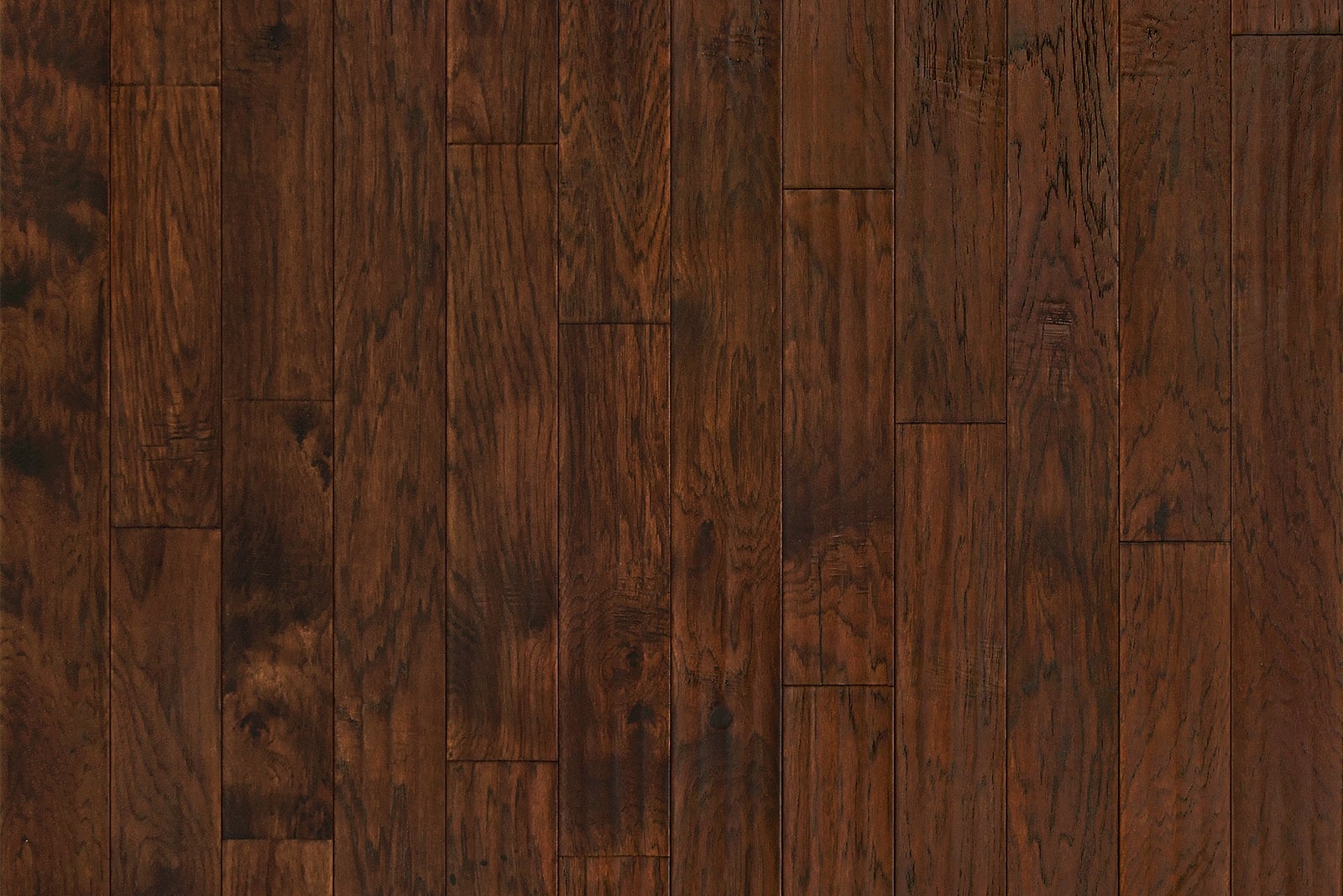
Reward EL PASO Hickory Bliss, Reward EL PASO Hickory Sunland, Reward EL PASO Hickory Resler and Reward EL PASO Hickory Falcon are 3/8" with a 1.2 mm wear layer, in the same bracket. Garrison Carolina Classic Charlotte and Garrison Carolina Classic Beaufort move to 1/2" with a 2.4 mm wear layer. Garrison Garrison II Smooth Chateau and Garrison Garrison II Distressed Chateau are 9/16" thick with a 4 mm wear layer. That is more hickory than any other engineered floor named here, and enough for a floor sander to take a pass from. Somerset WIDE PLANK Hickory Saddle lists a 3mm (nominal) wear layer on a SolidPlus Engineered (8 plies) core at 1/2" thick.
Solid hickory is the other answer, and the spec sheet marks it with the single word Solid on the construction line and no wear layer figure at all. A solid board can be sanded many times over its life, but it needs a wood subfloor to nail into and it moves more with the seasons than any engineered option. On a concrete slab in a single-storey house, common from San Jose out to Tracy, solid hickory is usually the wrong choice and engineered hickory is the right one.
Finish: what is on top of the hickory
Finish is the clear coat on top, and on nearly every hickory floor in our range it is a urethane carrying aluminum oxide. Garrison lists Urethane with Aluminum Oxide across its hickory. Reward lists UV Urethane finish w/ aluminum oxide on EL PASO, AVALON and PROVENCE III, and Anti-scratch finish with Aluminum Oxide on CAMINO II. Somerset lists Ultimate UV-Cured Aluminum Oxide/Urethane. The aluminum oxide is the part that resists scratching from grit. The urethane is the part that resists spills.
Sheen is the finish line that changes the look most. Ultra-matte, listed on the Reward wire-brushed and handscraped floors, hides scratches and makes hickory's colour variation read softer. Low Gloss, listed on the Somerset floors, reflects a little more light and shows the grain more sharply. Neither is a sealed waterproof surface. Hickory floors are not built for standing water, and the species line does not change that.
What hickory is wrong for
Hickory is the wrong floor for a bathroom or a laundry room, for the same reason every wood floor is: standing water finds the joints. It is the wrong floor for a room where you want a calm, even surface, unless you pick a dark stain in a sorted grade and accept that some sapwood will still show through. It is a demanding floor to install because the wood is hard on blades and fasteners, so follow the manufacturer's installation instructions and expect the installer to say so.
Hickory is the right floor for a hallway, a kitchen or a family room with dogs, where its hardness earns its keep. If the dogs are the deciding factor, our article on hickory or white oak for dogs covers the claw-mark question directly. If the room is wide and the stripes worry you, plank width changes how busy a hickory floor reads, and our guide to choosing plank width for your room walks through that.
Questions about hickory flooring
Is hickory harder than oak?
Yes. Garrison publishes a Janka rating of 1820 for its hickory floors, and hickory sits above both red oak and white oak on that scale. Hardness is about dents, not scratches. The finish handles scratches.
Why does my hickory sample look like two different woods?
Because it often is two parts of the same tree. Hickory sapwood is nearly white and the heartwood is reddish brown, and the mill does not sort them into separate boards. A Rustic or Mill Run grade shows more of this swing than a Select Character grade.
Can engineered hickory be refinished?
It depends on the wear layer line. A 4 mm wear layer like Garrison Garrison II Smooth Chateau can take a sanding. A 1.2 mm or 1.5 mm wear layer should be recoated, not sanded. The spec sheet tells you which you have.
Does hickory flooring work over a concrete slab?
Engineered hickory does, with a moisture check first and an installation method the manufacturer allows. Garrison lists Nail, Staple, Glue, Float for Garrison Carolina Classic Salem, and glue or float are the slab options. Solid hickory needs a wood subfloor. Our article on concrete slab moisture before flooring covers the test.
Which hickory floors can I see in my own room?
Every hickory floor named here has a product page with its photographs, and you can order a sample to lay in the room it is for. Start with Reward CAMINO II Hickory Natural if you want the full natural swing, or Garrison Garrison II Smooth Chateau if you want a 4 mm wear layer under a smooth face.
Reading the rest of the sheet
Once the species line is settled, the decision moves to grade, texture, wear layer and finish, in that order, and the spec sheet carries all four. Compare them side by side across the hickory floors in our flooring range, then book a free in-home laser measurement when the shortlist is down to two. Delivery and professional installation available across our service area.