
Herringbone oak flooring: what changes in the room
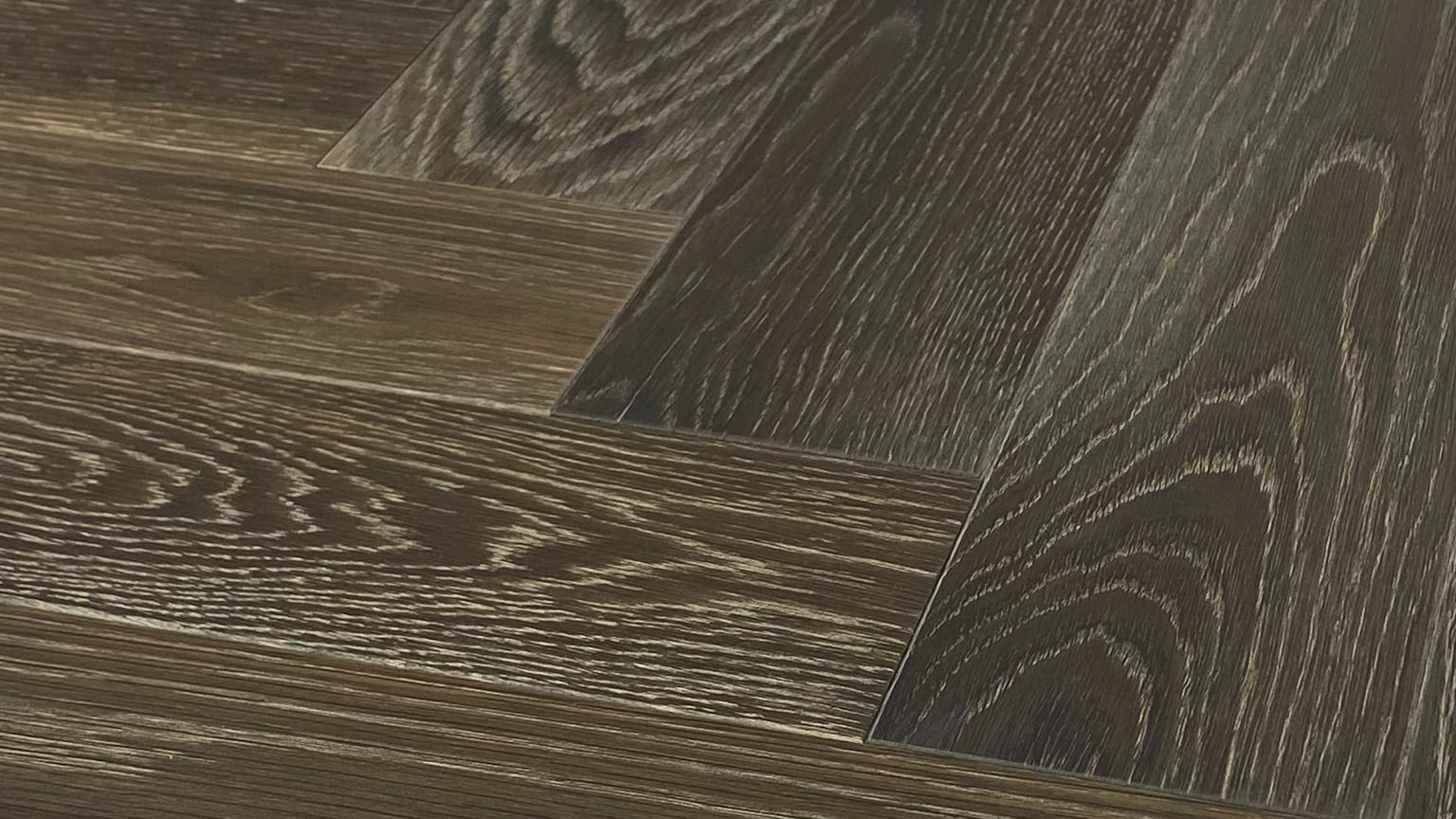
Herringbone oak flooring is worth choosing when the room is regular enough to show the pattern, and when you accept that the extra cost sits in the labour rather than the wood. The oak itself does not change. What changes is the layout, the waste, and how much the shape of the room matters.
The clearest way to see this is one collection sold both ways. Below, we hold the material still and look only at what the pattern changes, so you can decide for your own room rather than from a photograph.
Same oak, two layouts
The Monarch Plank Lago collection comes as a straight plank and as herringbone. The Monarch Plank Lago - Herringbone Moro and the Monarch Plank Lago Como plank share almost every line on the spec sheet. Both are European Oak, Rustic grade and wire-brushed.
Both are 9/16" thick, with a 3 mm wear layer over a Hardwood Plywood core. The one line that differs is width. The straight plank is 7" wide, and the herringbone piece is 4-3/8" wide.
That single difference carries the whole decision. A narrower piece, set at an angle to its neighbour, gives you far more joints, far more cuts at the walls, and a floor that reads as a pattern instead of as boards.
Because everything else is held constant, you are not choosing a better or worse oak. You are choosing a layout, and the hours it takes to put that layout down.
Rustic grade is worth a sentence here. It is a grading term that means the boards carry knots and colour variation between pieces. In a straight plank that character runs along the length of each board. In herringbone it is broken into short lengths, so the floor reads as busier but more even.
Where herringbone costs more, and it is not the wood
The common assumption is that herringbone costs more because the material is special. In this collection the material is the same oak with the same top layer. The difference is time and offcuts.
A straight plank floor starts at a wall and works across the room in rows. Herringbone starts from a layout line snapped down the centre of the room. Every piece is set against that line and against its neighbour, so the installer is checking the pattern continuously rather than row by row.
At the walls, every piece that meets the edge is cut at an angle. In a straight lay, only the ends of each row and the last row need cutting. In herringbone the whole perimeter is cut work, and so is every doorway, cabinet run and floor vent.
Those angled cuts also produce offcuts that are often too short or the wrong shape to use elsewhere. That is why the waste allowance for herringbone should be set for herringbone, not copied from a straight plank quote. Our guide on how to measure a room and allow for waste explains how that allowance is worked out.
If two quotes for the same room differ sharply, look first at the waste line and the labour line. The oak line is usually the one that moves least.
The room decides whether the pattern works
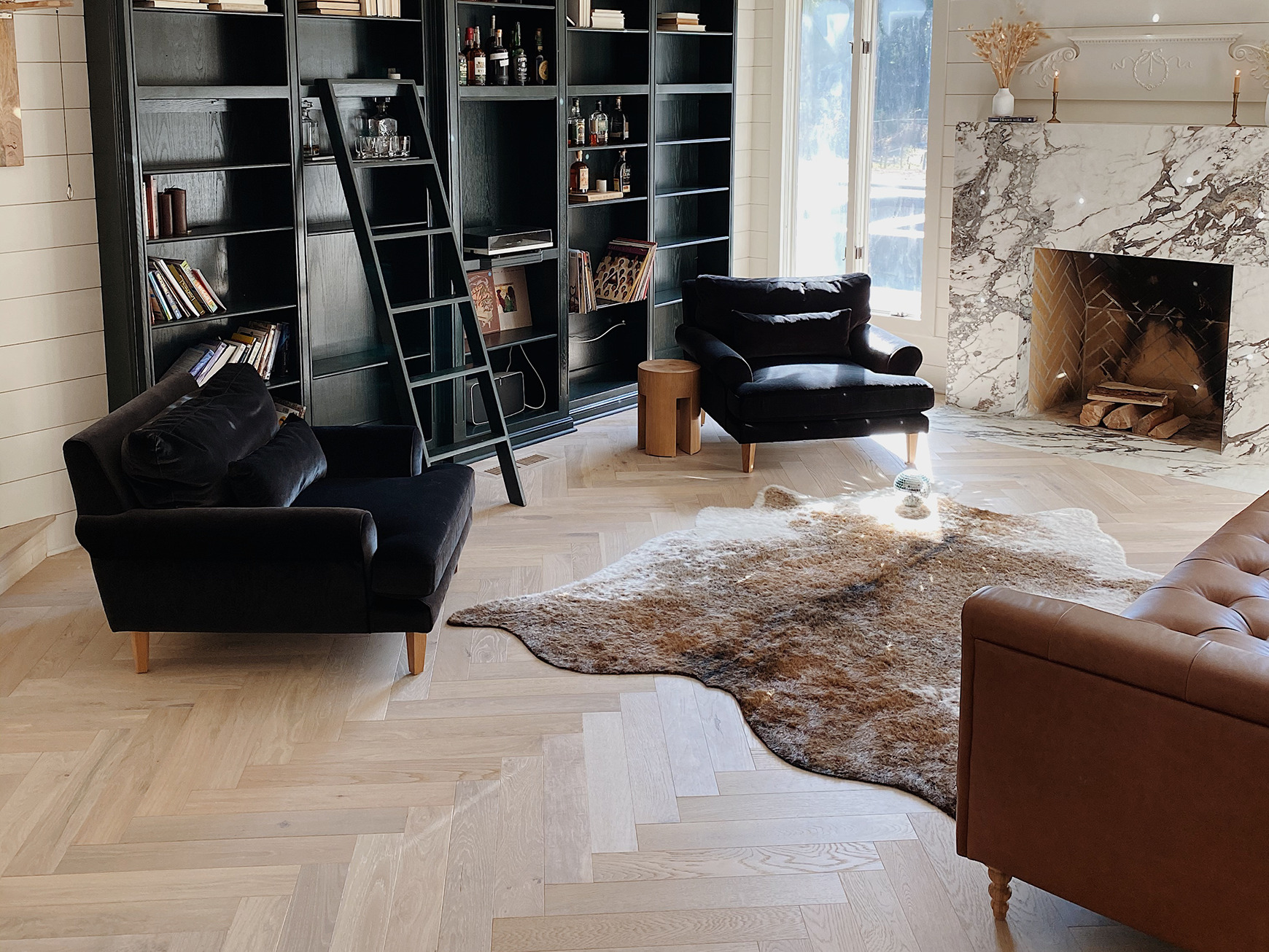
Herringbone has a direction. The points of the pattern run along one axis, and the eye follows them. Laid along the longest sightline, from the entry toward the far window or down a hallway, the pattern pulls the room lengthways.
Laid across that sightline, the same floor can make a long room feel chopped. Before you choose, stand where you enter the room most often and decide which way you want the points to travel.
Walls that are out of square matter far more with herringbone. A straight plank hides a wall that drifts, because the last row simply tapers a little. Herringbone exposes it, because the cut pieces along that wall change size from one end to the other.
You can check this yourself with a tape measure. Measure both diagonals of the room, corner to corner. If the two numbers differ noticeably, the room is out of square, and the layout needs planning around the wall you will see most.
Rooms joined by several doorways need another decision. The pattern can carry through each opening, or it can stop at a threshold and restart. Carrying it through looks continuous but needs the layout line to run through every room at once.
Herringbone tends to suit rooms with one clear axis: an entry, a hallway, a dining room, or a living room with a fireplace wall to aim at. It is harder to justify in a room broken up by an island, a peninsula and built-in cabinets, where much of the pattern ends in cut pieces.
What stays the same: wear layer, finish and water
The wear layer is the solid oak on top of the core, and it is what any future refinishing works in. Every Lago herringbone floor carries a 3 mm wear layer, the same as the straight Lago plank. If you want to understand what that thickness means over the life of a floor, read our note on how much wear layer you need.
The Lago herringbone range has a UV Urethane, Ultra-Matte finish over a wire-brushed surface. A textured, low-sheen floor shows fine scuffs less than a smooth, glossy one, because the texture already breaks up the light. It will still mark, like any wood floor.
Refinishing is where herringbone asks something extra. Because the pieces point in two directions, a sander crosses the grain on half the floor whichever way it travels. If the floor is ever sanded, ask the refinisher whether they have worked on herringbone before.
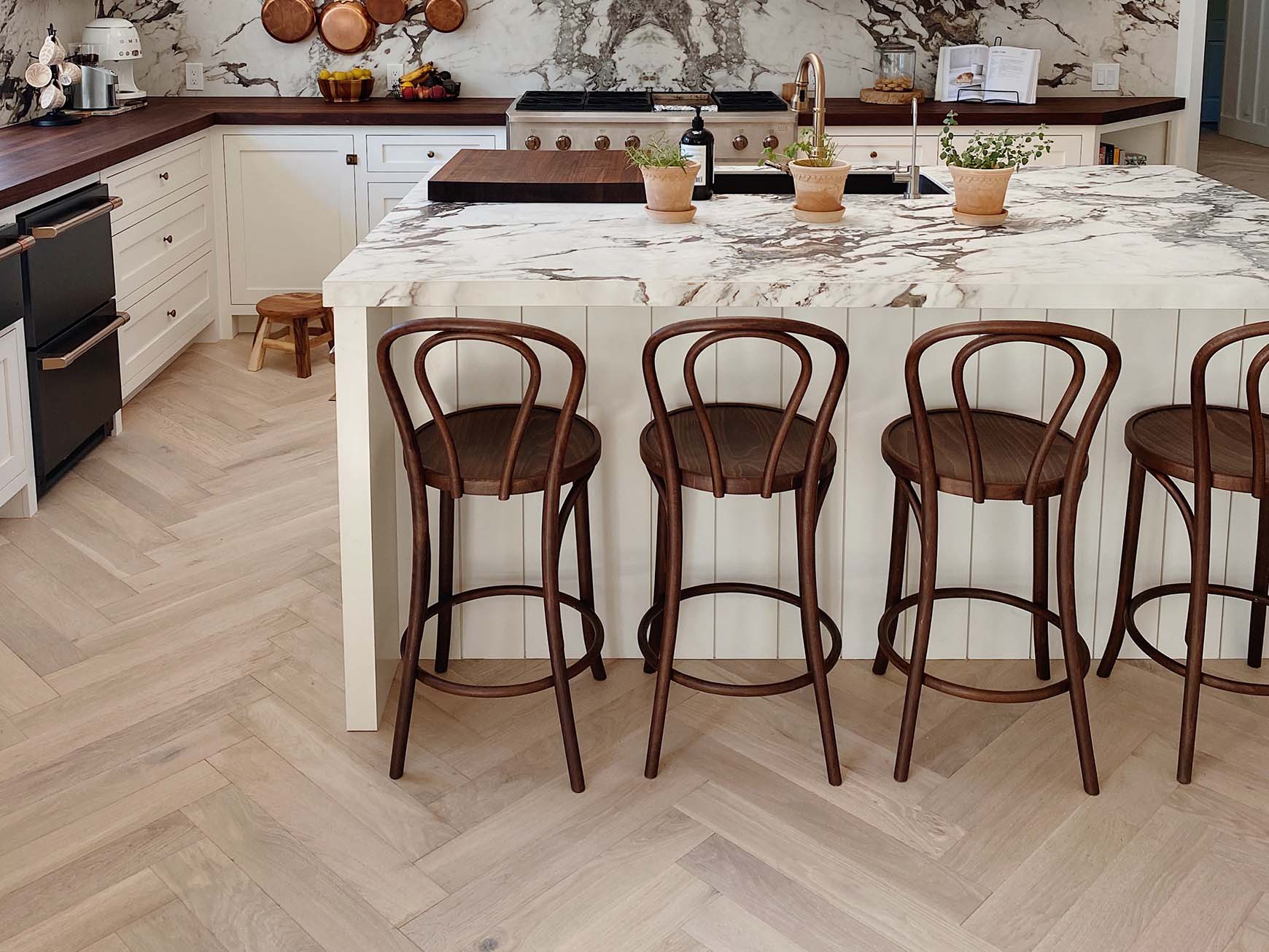
None of these floors is a waterproof floor. That makes herringbone oak the wrong choice for a bathroom or a laundry room, however good the pattern looks in a photograph. In a kitchen it is workable if spills are wiped up rather than left, and if the floor near the sink and dishwasher is watched.
The Hardwood Plywood core is what makes an engineered floor more stable than solid boards as the house moves through the seasons. It does not make the floor water-resistant. Standing water finds the joints, and herringbone has more joints than a plank floor.
Choosing a tone in the herringbone range
The Lago herringbone floors come in six versions: Ampola, Belviso, Bolsena, Como, Devero and Moro. On the spec sheet they are the same product. Each is European Oak, 4-3/8" wide, 9/16" thick, wire-brushed, with a 3 mm wear layer.
What separates them is the colour and character of the oak, and that is not something a spec sheet records. The room photographs of Devero and Como show a pale oak. The others are best judged in person.
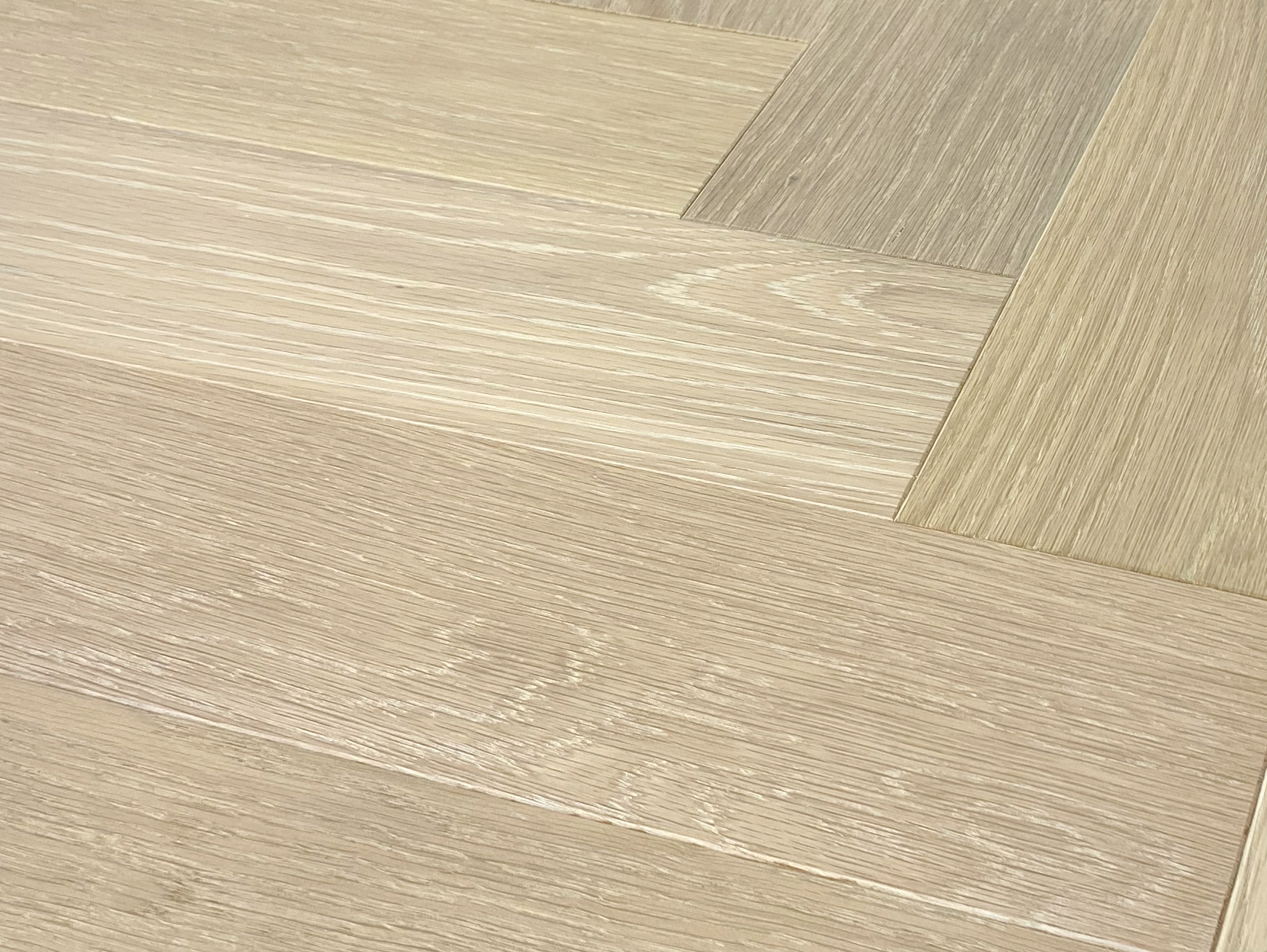
A matte, wire-brushed surface changes with the light far more than a photograph suggests. Morning light raking across the floor lifts the grain, and flat evening light quiets it. That is why we suggest you order samples of the two or three versions you are weighing and look at them on your own floor.
Put each sample down where the herringbone will run, not on a table by a window. Look at it at the time of day you use the room most. The version that looks right in the brightest light is not always the one that looks right in the room you actually live in.
When the straight plank is the better call
Being willing to talk you out of herringbone is part of giving a straight answer. There are rooms where the straight Lago plank is simply the better floor.
The first is a room that is badly out of square, where herringbone would put the error on show. The second is an open plan broken up by an island, a peninsula and a run of built-ins. Every obstacle is angled cut work, and much of the pattern ends up hidden under cabinets.
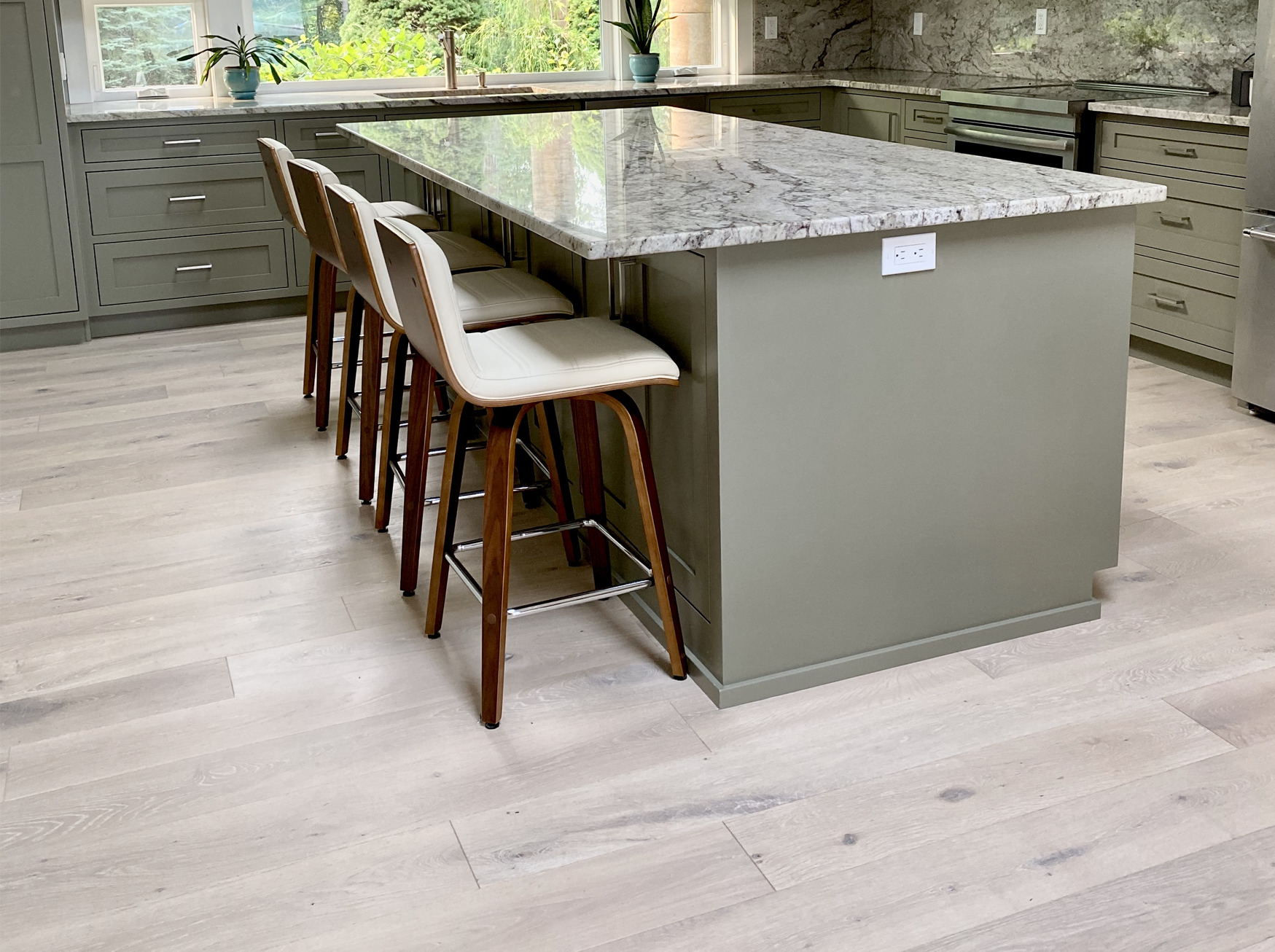
The third is a project where the labour budget is tight. The same oak and the same wear layer in a 7" plank goes down faster and leaves fewer offcuts. A Rustic grade also shows more of each board's character in a longer, wider plank.
There is also a middle path. Because the herringbone and the straight plank in this collection share the same 9/16" thickness, the two can meet at a doorway and sit level. Herringbone in the entry or the dining room, with the straight plank in the rooms beyond, keeps the same oak running through the house.
What we would ask before recommending herringbone
Before we would recommend herringbone for a room, we would want to know a few things. Is the room close to square, or does one wall drift? Where do you stand when you walk in, and which way should the pattern point?
We would also ask what is underneath. Small pieces follow the subfloor closely, so a dip or a hump that a long plank would bridge can show in herringbone. The subfloor often moves a quote more than the floor on top of it does.
Finally, we would ask which rooms connect to this one, and whether the pattern should carry through or stop at a threshold. Those answers settle the layout line, the waste allowance and the labour, which together decide the quote.
Our free in-home laser measurement answers the first of those questions with real numbers rather than estimates. The floor is then installed by licensed, insured, background-checked local installation partners, with the layout agreed before the first piece goes down.
Herringbone oak flooring questions
Is herringbone harder to install than a straight plank?
Yes. It starts from a layout line rather than a wall, every piece is checked against the pattern, and the whole perimeter is angled cut work. The oak is the same; the hours are not.
Does herringbone need a bigger waste allowance?
Usually, yes. Angled cuts at every wall and doorway leave offcuts that often cannot be reused. Ask for the allowance to be worked out for herringbone in your specific room.
Can herringbone oak go in a kitchen?
It can, with care. The Lago herringbone floors are not waterproof, so spills need wiping up and the area around the sink needs watching. For a bathroom or a laundry room, choose a waterproof floor instead.
Can I use herringbone in one room and straight plank in the next?
Yes, and in this collection it works well. The Lago herringbone and the Lago plank are both 9/16" thick, so they meet level at a doorway, with European Oak on both sides.
Is this herringbone a solid wood floor?
It is an engineered floor. The top is a 3 mm layer of European Oak, bonded to a Hardwood Plywood core, for a total thickness of 9/16".
Where to go from here
If one room in your house has a clear axis and walls close to square, herringbone is worth pricing properly. Start with the Monarch Plank Lago - Herringbone Devero page to see the pattern and its full specifications. When you know the room, request a quote and we will work out the layout, the waste and the labour for that room specifically.