
Entryway flooring: grit, wet shoes and the finish
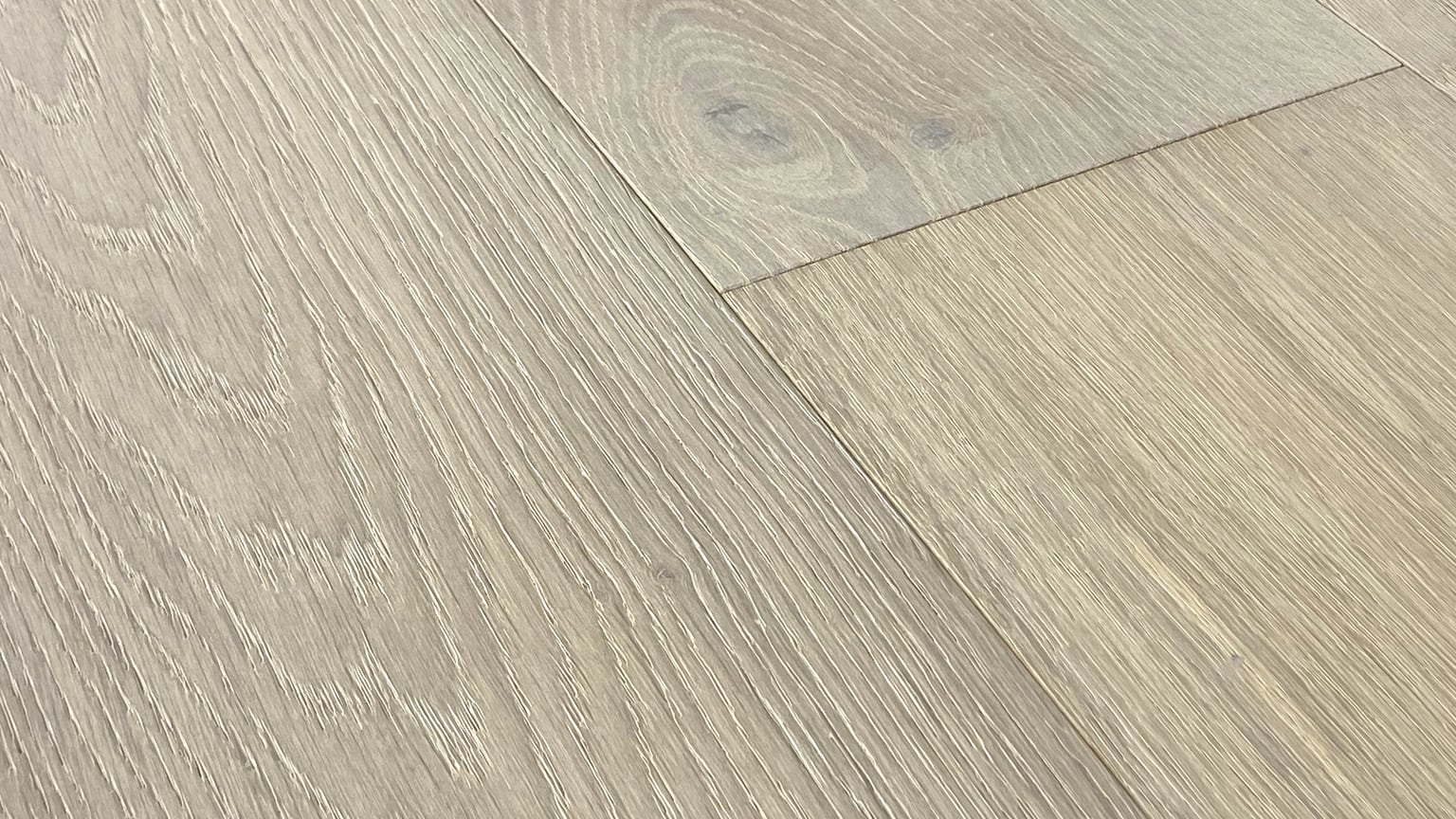
Entryway flooring fails at the finish long before it fails anywhere else. Grit carried in on shoes works like fine sandpaper, and wet soles leave water right where you stand to take them off. The structure underneath is rarely the problem.
So the floor that holds up in an entry is chosen for its surface. It needs a texture and colour that hide fine scratches, enough wood on top to sand back later, and a height your front door can clear.
For a wood floor, that usually points to a wire-brushed or hand-scraped engineered oak with a matte finish and a thick top layer. It also means being straight about water, because none of the wood floors named here are waterproof.
Why an entry floor wears out at the surface
An entry is a small room that sees every trip in and out of the house. Each step drags whatever came in from the path, the driveway or the street across the same short stretch of floor. Sand and grit are harder than a floor finish, so they scratch it.
A living room gets its traffic spread across a wider floor, and much of it arrives in socks. The entry takes it concentrated and unfiltered. That is why the first sign of wear in a house is often a dull, hazy patch just inside the front door.
The finish is the layer that takes this punishment. On every floor in this article, it is UV Urethane, Ultra-Matte.
That sheen matters at a door. A glossy finish shows each fine scratch as a line of reflected light. A matte one scatters the light, so the same scratch is much harder to see from standing height.
Texture and colour decide how scratches read
A smooth floor shows a scratch as a clean line across an even surface. A wire-brushed floor already has the soft grain pulled out of the face, so a new scratch lands among texture that was there when the floor went down. Hand-scraped boards do the same with broader, shallower tool marks.
That is the practical case for texture at the door. Monarch Plank Tableau Sisley is a wire-brushed European Oak in a Rustic grade, 8-5/8" wide. Its sister floor, Monarch Plank Tableau Cezanne, is the one in the photograph at the top of this article.
Grade matters as much as texture. A Rustic grade allows knots, filled cracks and a visible shift in colour from board to board. In an entry, that variation absorbs a dent from a dropped key or a scuff from a boot heel, because the eye already expects an irregular floor.
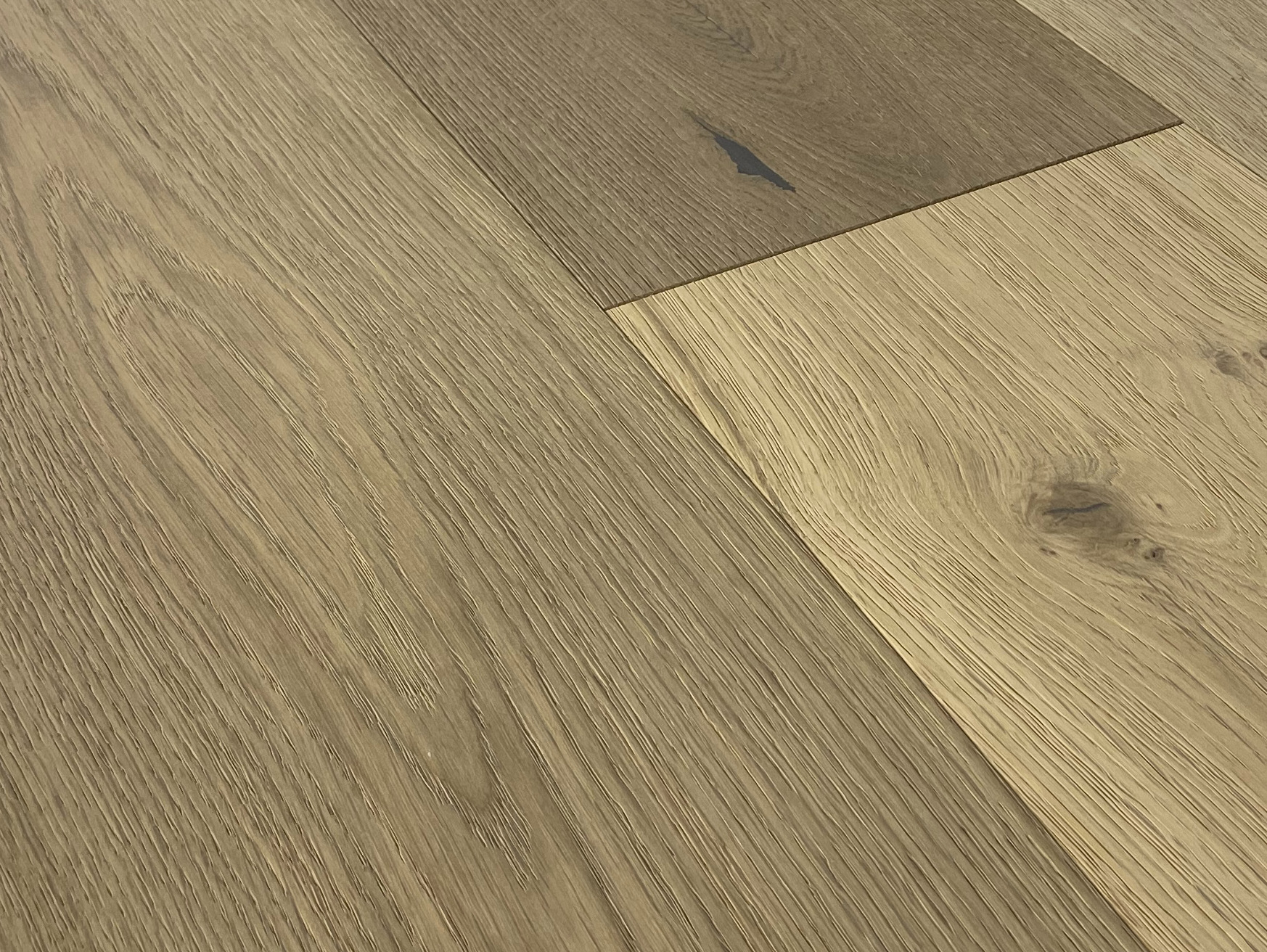
Colour works the same way. A mid-tone floor hides dust and grit better than a very dark or a very pale one. Dark floors show pale dust and any scratch that exposes lighter wood, while pale floors show tracked-in dirt and dried water marks.
The honest counterexample is a smooth, clean floor. Monarch Plank Premio Veranda is a Red Oak in a Prime grade with a smooth texture. It reads calm in a living room, and that same even surface is the one that shows scratching first at a busy front door.
The top layer is what you can sand back
These floors are engineered: a layer of real oak sits on a base of hardwood plywood or hardwood lumber. The top layer, listed as the wear layer, is the only part that can be sanded and refinished. Its thickness decides how often an entry can be brought back after the finish wears through.
The spread in this group is wide. The Lago floors carry a 3 mm wear layer, and the Tableau, Premio and Regent floors carry 4 mm. The Domaine II and La Grande floors carry 6 mm, which leaves more wood to sand into than the others here.
The entry is the room where a refinish tends to come first. If you want the option to sand the doorway without replacing boards, the thicker top layer is worth weighing. Our guide to how much wear layer you need walks through that choice room by room.
Sanding an entry on its own is rarely invisible, though. A refinished patch can read slightly differently from the untouched floor beside it. That is one more reason to choose a surface that hides wear from the start, and to keep a coarse mat outside the door.
Water at the door, and where wood is the wrong floor
Every product named in this article is a wood floor, and none of them is waterproof. Wood takes up moisture and gives it back, so a puddle left at the door can mark the finish or swell the edges of the boards. That is the honest limit of oak at a front door.
For an entry under a porch roof that sees wet shoes now and then, engineered oak with a matte urethane finish is a reasonable choice. Wipe up water when you come in, and keep an absorbent mat inside the door. Wet umbrellas and boots belong on a tray, not on the boards.
Engineered oak is the wrong floor for an entry that opens straight onto a pool deck, a garden hose or a side yard where rain blows under the door. There, a waterproof floor from the full flooring range is the better call, and we will tell you so. If a dog also uses that door, our notes on claws and water bowls cover the same problem from another side.
Height, the front door and the next room
Thickness is the detail people miss at an entry, because the front door has to swing over the new floor. The Domaine II floors are 3/4" thick, the Tableau and Premio floors are 5/8", and the Lago floors are 9/16".
A new floor that sits higher than the old one can stop the door clearing, or leave an awkward lip at the threshold. Check the gap under the door before you choose, not after the boxes arrive.
The entry also meets other floors: a hallway, a living room, sometimes a kitchen. Where two floors of different thickness meet, the join needs a reducer or a threshold piece. Follow the manufacturer's installation instructions on expansion space at the door and along the walls.
A thinner floor gives you more room at a door that already sits low. Monarch Plank Lago Moro is a wire-brushed European Oak, 9/16" thick and 7" wide, on a hardwood plywood base. The trade is its 3 mm wear layer, which leaves less wood to refinish later.
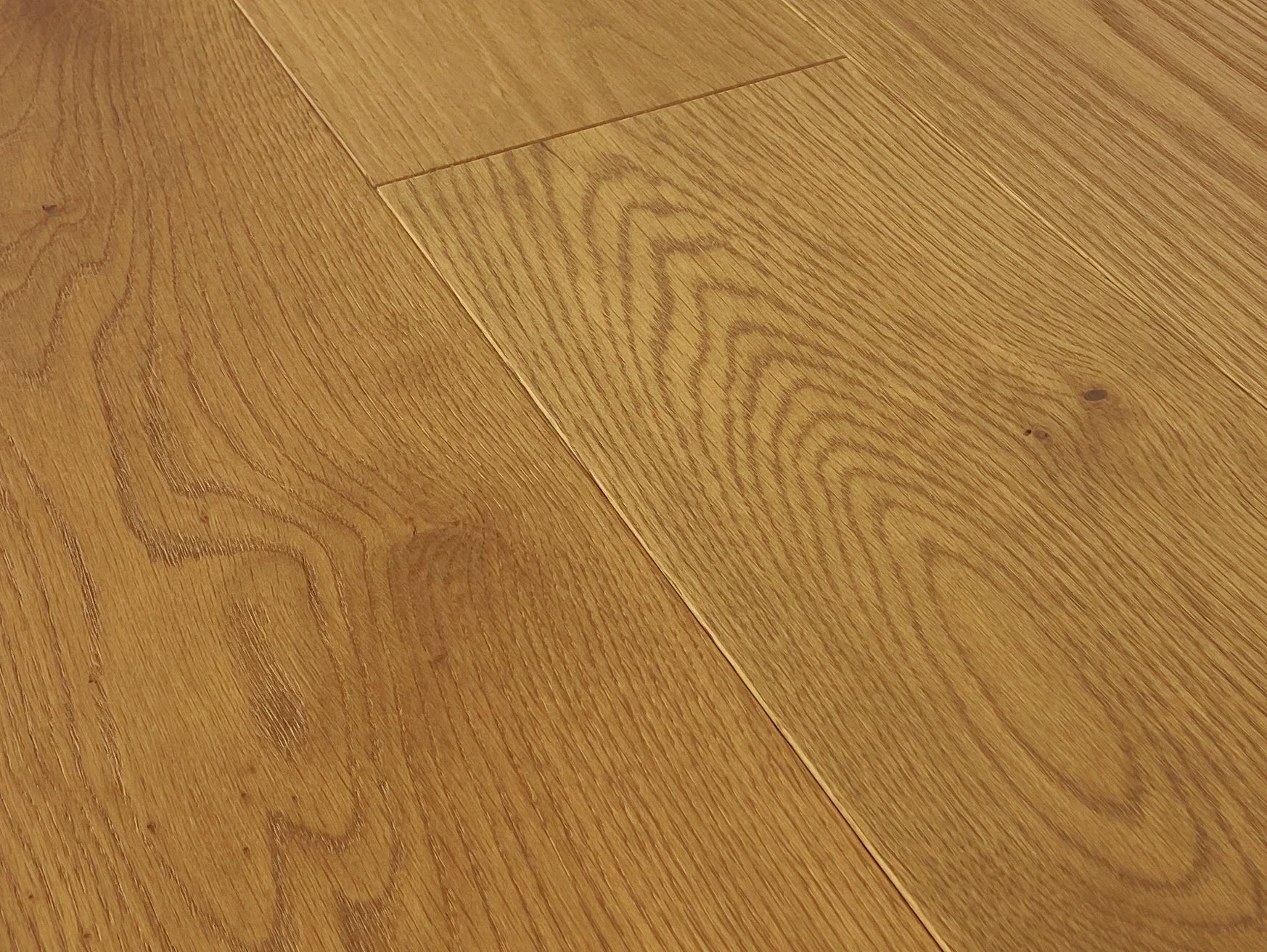
Its sister floor in the same collection, Monarch Plank Lago Belviso, shows how that build looks up close. You can see the grain, the small knots and the seams between planks, which is the level at which grit does its work.
Plank width and herringbone in a small entry
An entry is often narrow, and plank width changes how it reads. A wide board such as Monarch Plank La Grande Parsenn, at 11-3/8", shows few joints across a small space, which looks calm. It also means each board carries more of the room, so one scratched board stands out more.
Herringbone works the other way. Short pieces set in a zigzag break the floor into small panels, so a scratch never runs far along one board. The pattern also makes a plain entry look deliberate, which is why it is often chosen for the first room a guest sees.
The trade-off is labour. Herringbone asks more of the installer than straight plank, especially where the pattern meets a door frame and the walls. Monarch Plank Domaine II - Herringbone Montrichard is a hand-scraped European Oak, 4-3/4" wide and 3/4" thick, with a 6 mm wear layer.
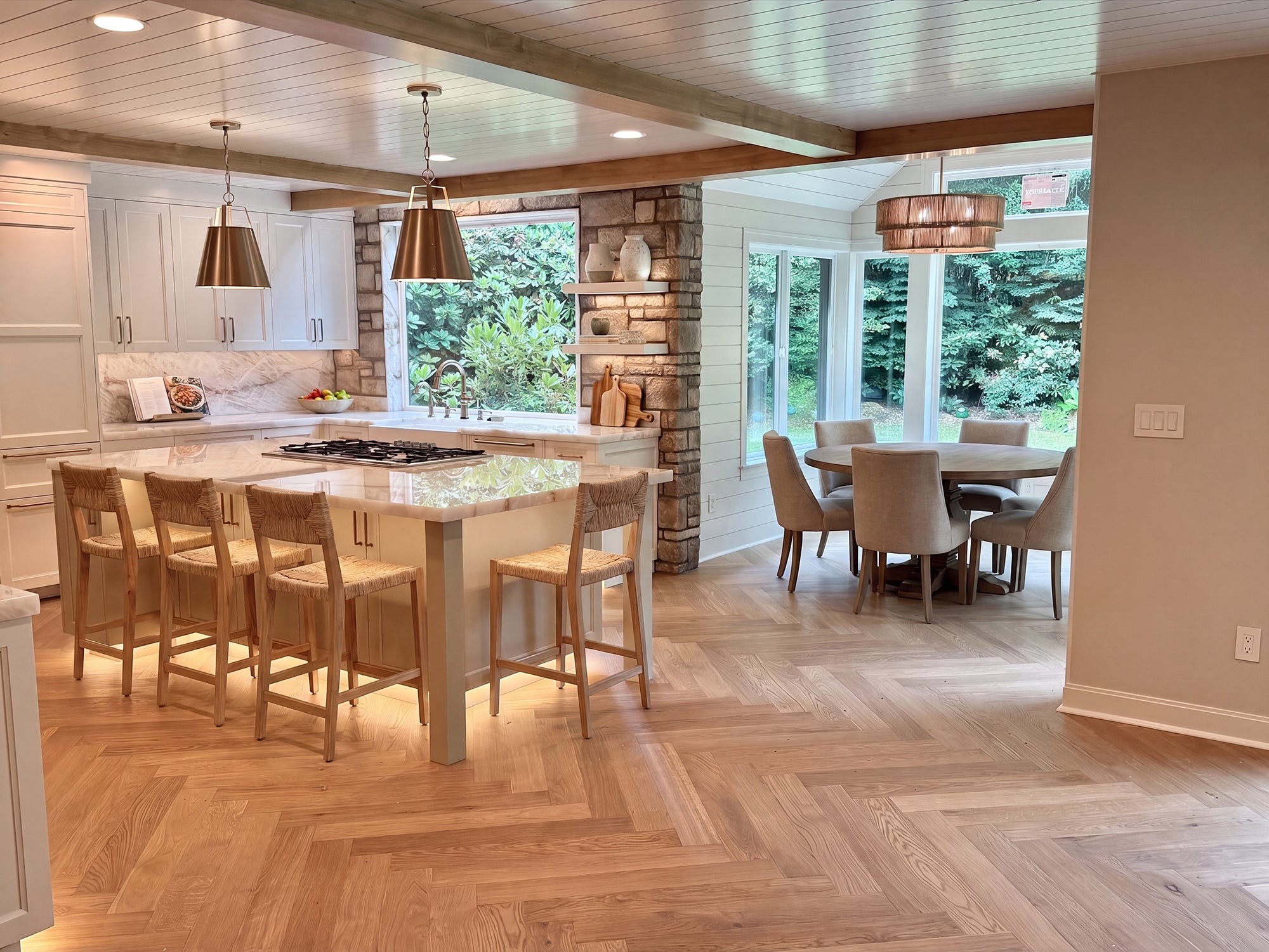
Herringbone also solves the transition problem when the entry opens into the rest of the house. Laid through a kitchen and dining room, as in the photograph below, the pattern runs as one floor with no join at the doorway.
What we would check in your entry before recommending a floor
We would not recommend an entry floor from a photograph alone. These are the questions we ask at the door itself.
- What is directly outside: a covered porch, a paved path, a lawn or a pool deck. That decides how much grit and water reach the floor.
- Whether rain can reach the threshold, and whether water has already marked the old floor.
- How much room there is under the front door, and how the threshold sits today.
- Which floors the entry meets, and whether you want one floor running through or a clean break.
- The condition of the subfloor. The floor is rarely what moves your quote; the subfloor underneath it often is.
- Who else comes through the door, including dogs.
The simplest way to answer all of that is a free in-home laser measurement. We measure the entry and the rooms it opens into, look at the door and the threshold, and tell you which floors suit it and which do not.
Entryway flooring questions
Is engineered oak a sensible choice for an entryway?
Yes, for a covered entry where water is wiped up rather than left to sit. Choose a wire-brushed or hand-scraped texture and a matte finish. For an entry that regularly gets wet, choose a waterproof floor instead.
Which texture hides scratches at the front door?
Wire-brushed and hand-scraped surfaces hide fine scratches better than smooth ones. The texture gives a new mark somewhere to disappear. A Rustic grade with knots and colour variation helps in the same way.
Can I sand just the entry later?
You can, if the wear layer allows it, but a refinished patch may not match the floor around it. A thicker wear layer gives you more room to sand. Hiding wear in the first place is the easier path.
Is herringbone practical in an entry?
It is. The short pieces break up scratches and the pattern suits a first room. Expect more installation work at door frames and walls than with a straight plank floor.
Should the entry match the rest of the floor?
Running one floor through avoids a threshold piece and reads as one space. A separate entry floor makes sense when the entry takes water that the rest of the house never sees.
Do you install entryway flooring?
Yes. We offer delivery and professional installation available across our service area, carried out by licensed, insured, background-checked local installation partners. It starts with a free in-home laser measurement.
Where to start
Hold a few boards in your own entry before you decide, in the light that comes through your front door. You can order samples of the oak floors named here, then compare their texture, colour and thickness side by side. When you are ready to see the rest, browse the engineered oak and waterproof floors in our flooring range.