
Engineered hardwood in a kitchen: what to check
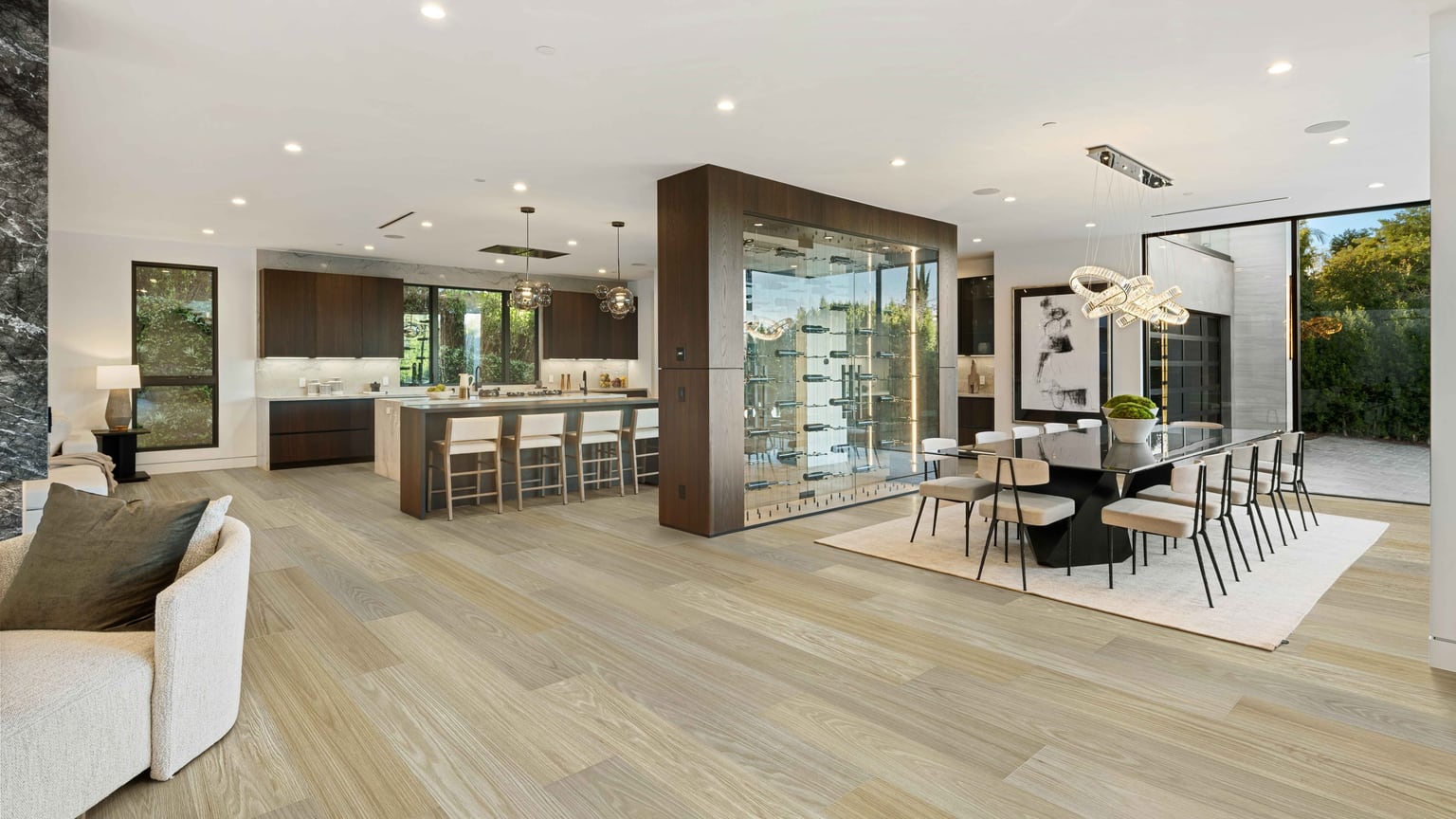
If you want real wood underfoot, engineered hardwood in a kitchen is usually the right construction. Its cross-layered core keeps the boards flatter through cooking steam and seasonal humidity than solid wood does, and it can be glued to a concrete slab.
It is still wood, and none of the floors named below are waterproof. If your kitchen regularly sees standing water, a floor with a waterproof core is the honest answer, and the wood belongs in the rooms beside it.
A kitchen asks two things of a floor. It takes water at the sink and the dishwasher, and it takes dropped weight everywhere else. Construction decides how a floor handles both, well before colour does.
What engineered and solid construction actually mean
Solid hardwood is one piece of wood from top to bottom. Engineered hardwood is a top layer of real wood, called the wear layer, bonded to a core of thin wood plies laid at right angles to each other. Those crossed plies resist the swelling and shrinking that a single board does across its width.
Solid flooring is usually sold as narrow strip, and that narrow width is how it manages movement. Each board is small, so each gap or swell stays small. Solid strip is generally nailed to a wooden subfloor, so a concrete slab needs extra work first.
Garrison Greek Isles Mykonos is Engineered, 5/8" thick and 9-1/2" wide, on a Birch Multi-Ply substrate. A plank that wide is practical in a kitchen because the core holds it flat. Cut as solid wood, a board that wide would cup and gap far more as the humidity in the room changed.
That is the core of the decision. Engineered construction lets you have a wide plank, a slab installation and a stable floor in a room full of steam. Solid construction asks for narrow boards and a wooden subfloor, and it repays you with more wood to sand over its life.
Water at the sink: what wood can and cannot take
A finish slows a spill down. It does not make a wood floor waterproof, because water finds the joints between boards and reaches the edge of the core. A wiped spill is fine; a slow leak under a dishwasher is not.
Check three places in your own kitchen before you choose wood. Look under the sink cabinet for old staining, behind the fridge if it has an ice maker line, and around the dishwasher door seal. If any of them has leaked before, plan for it to leak again.
If that check worries you, read how rigid vinyl and laminate cores compare before committing to wood. Plenty of households run a waterproof floor in the kitchen and wood from the doorway on. The trade-off is a threshold strip where the two floors meet.
One wood construction handles water at the joints better than the rest: an unfinished, square-edge white oak plank that is sanded and finished after it goes down. Because the finish is applied in place, the coats run across the joints instead of stopping at the edge of each board.
The trade-off is time and disruption. The kitchen is out of use while the finish goes on and cures, so follow the finish maker's instructions and plan your meals elsewhere. For many households that settles it, and a factory finish wins.
Dropped weight: hardness, texture and the wear layer
A dropped pan tests how hard the wood is, how much the surface hides, and how much wood is left to sand later. Hardness is published as a Janka rating. Garrison Gold Lable Linen is American Oak with a Janka rating of 1360, and Garrison Competition Buster Birch Spice lists 1260.
Neither number makes a floor dent-proof; in a kitchen, texture changes the result more. Garrison Gold Lable Linen is Light Wire Brushed. Garrison Competition Buster Birch Spice is Hand-Scraped Beveled and Distressed with Chatter, so a fresh dent reads as part of the surface rather than a flaw.
Garrison Competition Buster Birch Spice is also a dark Engineered floor on a Multi-Ply Birch substrate, 3/8" thick. In a room with strong daylight, its dark brown tone and worked surface show the grain clearly while small marks disappear into it.
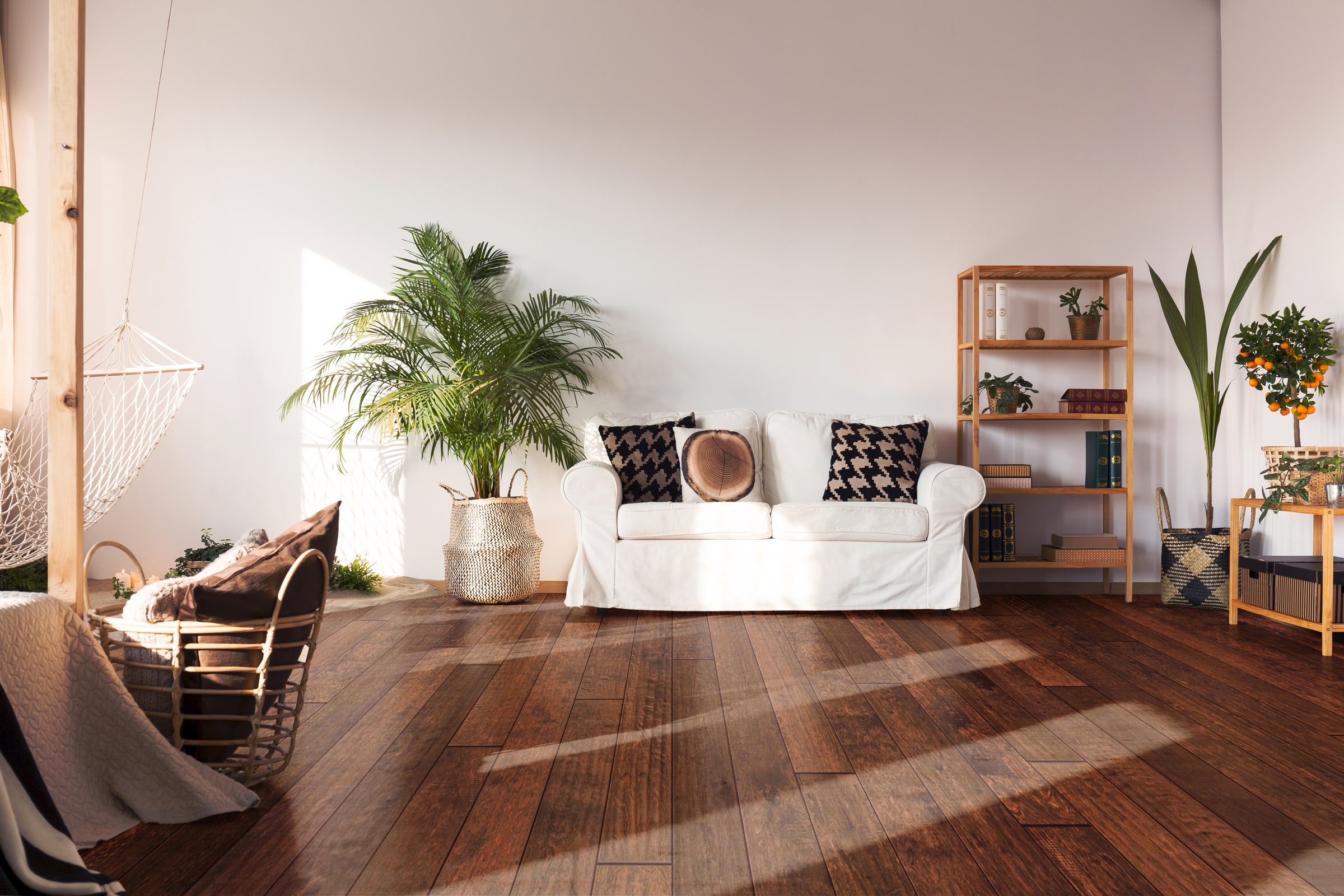
The wear layer decides what happens after the dents. On Garrison Competition Buster Birch Spice it is 1.5 mm, the same as on Reward AVALON Euro Oak Gareth. A layer that thin leaves little room for a full sanding, so plan to maintain the finish rather than sand it back.
Garrison Gold Lable Linen and Garrison Greek Isles Mykonos each carry a 4 mm wear layer. A thicker wear layer leaves room to sand out kitchen wear and refinish the floor later. In the room that takes the most abuse, that reserve of wood is worth more than anywhere else in the house.
Finish: urethane or oil in a working kitchen
Factory finishes come in two families, and they behave differently at a sink. Garrison Greek Isles Mykonos and Garrison Beverly Hills Rexford use Urethane with Aluminum Oxide, a hard film that sits on top of the wood. Spills bead on it, but a deep scratch shows as a pale line, and repair usually means recoating the whole room.
Garrison Gold Lable Linen and Garrison Du Bois Gabrielle use UV Oil, which soaks into the wood instead of forming a film. A worn patch in front of the sink can be cleaned and re-oiled on its own. The trade-off is upkeep: an oiled floor needs a maintenance coat now and then, and water left standing marks it sooner.
Sheen matters as much as chemistry. A semi-gloss floor shows crumbs and scuffs under bright kitchen lights. Reward AVALON Euro Oak Gareth is Ultra-matte, and a low sheen like that hides daily wear far better.
A galley kitchen shows these choices most clearly, because everyone walks the same narrow line between the counters. A very pale oak keeps that walking line from reading as a worn path. Garrison Beverly Hills Rexford is Euro Oak, 9-1/2" wide, with a Micro-Beveled edge and a Light Wire Brushed surface.
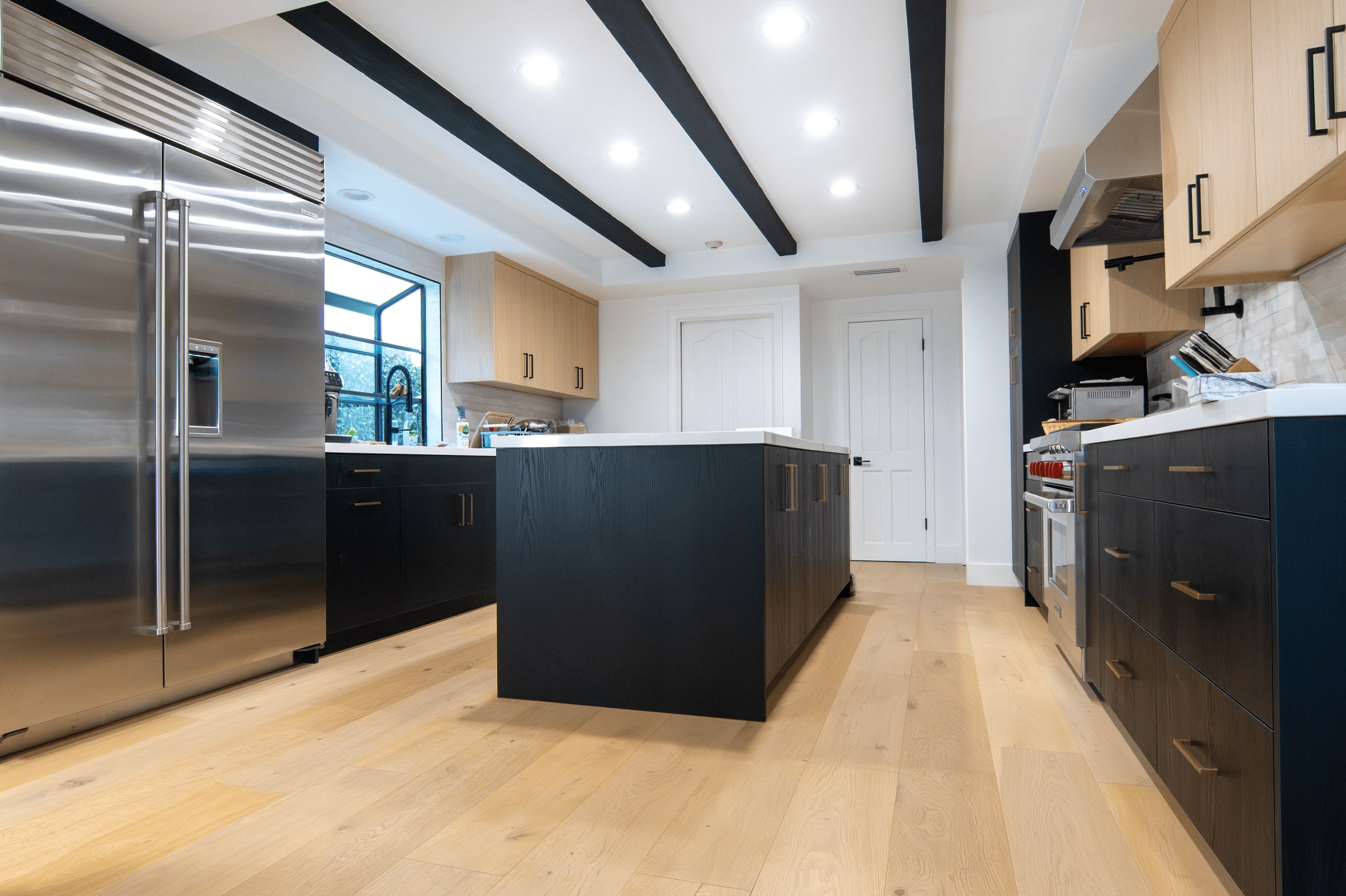
The edge detail is the one most people miss. A Micro-Beveled edge leaves a small groove at every joint, and in a kitchen that groove collects crumbs and holds a spill a little longer. A square-edge floor finished in place sweeps flat.
Thickness, height and the cabinets
Kitchens are where floor height causes trouble. A dishwasher slides into a fixed opening under the counter, and a thicker new floor can trap it in place. Check that opening before you choose, or ask whoever measures the room to look at it.
Garrison Competition Buster Birch Spice and Reward AVALON Euro Oak Gareth are both 3/8" thick. Garrison Gold Lable Linen and Garrison Greek Isles Mykonos are 5/8". The thinner floors are easier to match to an existing dishwasher opening and to the floor in the next room.
Then decide how the floor is held down. Garrison Gold Lable Linen lists Glue Down and Floating, and Garrison Greek Isles Mykonos lists Nail, Staple, Glue and Float. On a concrete slab, glue or a floating installation is the usual route, and our guide to flooring for a damp concrete slab covers the moisture test that comes first.
A floating floor has one kitchen rule of its own. It must be free to move, so it should never be pinned under base cabinets or a heavy island. The usual approach is to lay it up to the cabinets and cover the edge with trim, leaving the gap the manufacturer's installation instructions call for.
What we would ask before recommending a kitchen floor
Before we suggest a construction, we want a handful of answers about your kitchen. Each of them changes the recommendation more than colour does.
- Is the kitchen on a concrete slab or a wooden subfloor?
- Has the sink, the dishwasher or the fridge water line leaked before?
- Does the floor continue into a living or dining area without a break?
- Will you re-oil a floor now and then, or do you want a finish you simply clean?
- Does the dishwasher opening leave room for a thicker floor?
An open plan changes the answer most. When the kitchen floor runs straight into the living room, the whole run is usually one product, so the kitchen sets the choice for both rooms. A wide engineered plank such as Garrison Gold Lable Linen, 9-1/2" wide, suits that kind of long, open run.
The simplest test is to order samples of the floors you are weighing and leave them by your own sink. Drip water on them, drop a spoon, wipe them with your usual cleaner, and look at them under your own kitchen lights. A sample that annoys you there will annoy you more across the whole floor.
Questions about kitchen floor construction
Is engineered hardwood okay next to a dishwasher?
Yes, if leaks are caught early. The finish handles daily drips, but a slow leak that sits under the floor will damage any wood construction. A leak sensor under the dishwasher is a sensible addition.
Can engineered hardwood go over a concrete slab?
Usually, yes, either glued down or floating, depending on what the product lists. The slab must pass a moisture test first. Solid hardwood is much harder to lay over a slab because it is generally nailed.
Should a wood floor go under the kitchen cabinets?
A floating floor should not, because the cabinets pin it and stop it moving. A glued or nailed floor can, but in most remodels the cabinets stay where they are and the new floor meets them. Ask about appliance clearances before deciding.
Is solid hardwood ever the right kitchen floor?
It can be, over a sound wooden subfloor in a kitchen with no leak history. Narrow solid strip handles movement through its small board width. Over a slab, or in wide planks, engineered is the safer construction.
Does a matte finish really hide kitchen wear?
It hides it better than a shinier one. A low sheen scatters light, so fine scratches and footprints read less clearly. A textured surface such as wire brushing helps further.
The next step for your own kitchen
If you are weighing engineered against solid for your own kitchen, the useful next step is to have the room looked at properly, including the dishwasher opening and the subfloor. Book a free in-home laser measurement through our quote request page, and we will tell you which construction suits the room before you commit.