
Hallway and stairs flooring: what to check first
Hallway and stairs flooring should be chosen from the stair up, not from the hall down. The hall carries more foot traffic than most rooms, but the stair decides which floors are even possible. Pick a floor that can be fixed to every tread and finished cleanly at the front edge, then run that same floor through the hall.
That order matters because a hall is forgiving and a stair is not. Almost any sound floor will survive a hallway if the finish suits the traffic. Very few floors look right turning down a flight of stairs.
What the stair rules out first
A stair tread is a small, separate surface that you step onto with your full weight, often quickly and often in socks. Every piece has to stay exactly where it was put. That is why a floating floor, the kind that clicks together and rests on an underlayment, is the wrong floor for a stair.
Floating floors work because the whole room moves slightly as one sheet. Cut into tread-sized pieces, there is no sheet left to hold anything, so each piece has to be glued or mechanically fastened. Check the installation method on the product page before you look at colour.
The Garrison Beverly Hills Canon lists Glue Down, Floating, and Nail/Staple (Glue Assist) as its installation methods. A floor that can be glued or nailed has a path onto a stair. A floor listed only as floating usually does not, and no finish or colour changes that.
The same logic applies to the landing and the bottom step. If the hall floor floats and the stair is glued, the joint between them needs a transition that lets the hall move while the stair stays fixed. Your installer should be able to show you where that joint will sit before work starts.
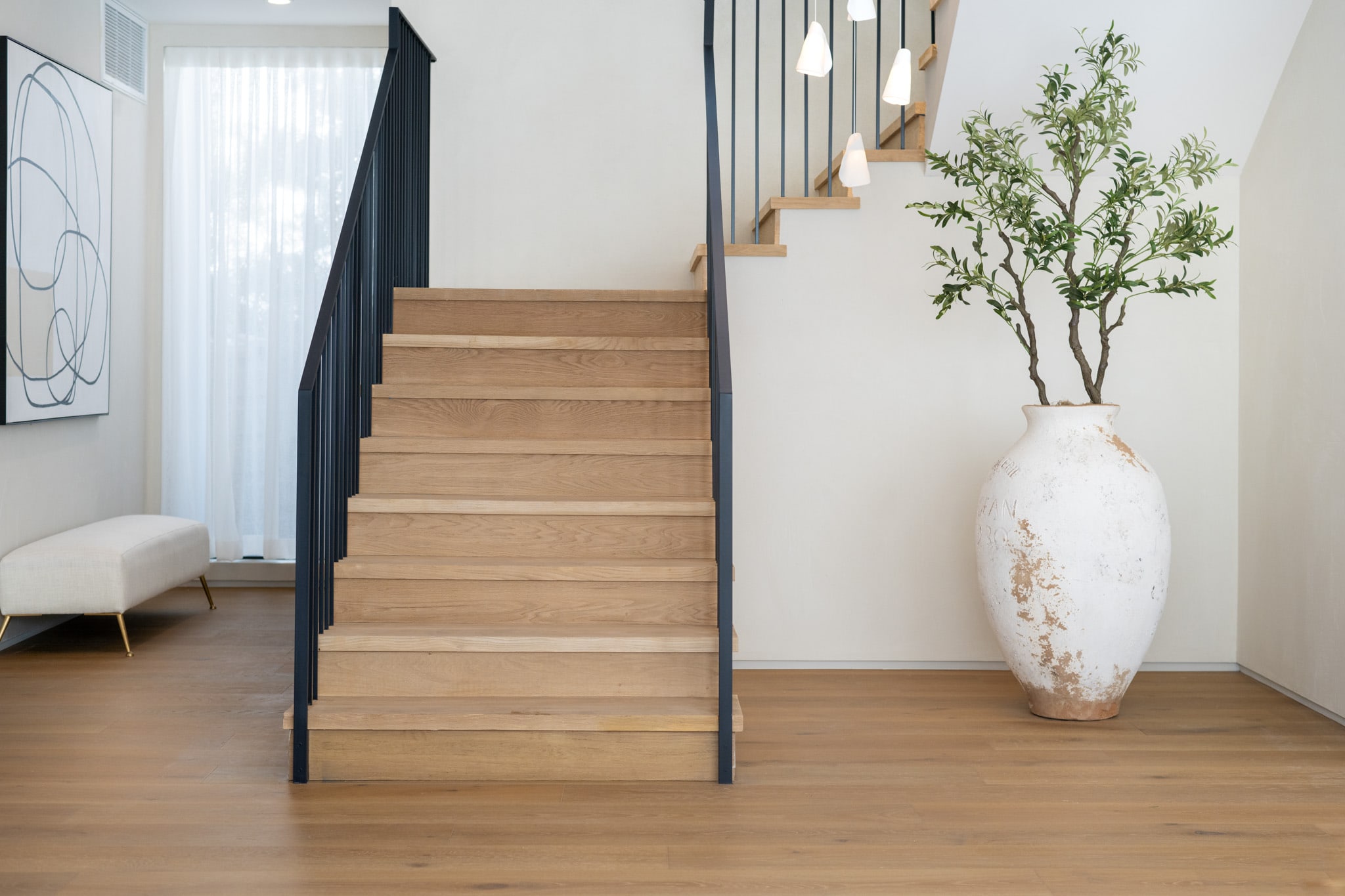
In the photograph below, one warm oak runs across an entry hall and up a set of open wooden treads beside a black metal railing. That continuity is what you are aiming for. One species and one surface from the hall floor to the top step reads as a single decision.
The nosing is the detail that shows
The nosing is the front edge of each tread, the part your heel lands on and your eye reads from the bottom of the stairs. Every step on the flight lands on it. If it is going to fail anywhere, it fails there first.
There are three common ways to finish it. Some manufacturers make a matching stair nose piece that sits over the plank edge. Ask whether one exists for the exact floor you are considering, because a near match in colour looks worse on a stair than an honest contrast.
The second way is a solid wood tread, made and finished to sit with the hall floor. The third is a floor finished on site, where the hall and the treads are sanded and coated together. With the third approach the colour is one colour, because it is literally the same coat.
Open stairs add one more detail. Where a tread is exposed at the side, the end grain needs a return, a piece that wraps the visible end. A closed stair, boxed in by walls on both sides, hides that end and makes the job simpler.
Why a floor finished on site suits stairs
The Garrison Contractor's Choice Red Oak is supplied unfinished, with a square edge, a 4 mm wear layer and a Premium grade. Because it arrives raw, it can be laid in the hall, fitted to the treads and finished in one pass. The bottom step then matches the bedroom doorway, because the finish went on both together.
The square edge helps a hall as well. Micro-beveled planks have a small groove along each joint, and grit from shoes collects in it. A square-edged floor sanded flat leaves no groove for the grit to fill.
The trade-off is the finishing itself. Sanding produces dust, the floor is off-limits while each coat cures, and you choose the finish rather than taking one chosen at the factory. For a hall that connects every room, plan how the household gets around while it is done.
A solid floor is the traditional stair answer, because the same board can be sanded again when the nosing wears. If you choose a prefinished solid strip instead, look closely at its sheen. Semi gloss reads crisp on a stair, but it shows scuffs in a hall sooner than a matte surface does.
The Garrison Contractor's Choice Red Oak is a 2-1/4" strip with a Janka rating of 1290. Red oak has a warmer, pinker cast than white oak, so hold a board against your existing trim before you choose.
What the hallway asks of the finish
Halls take traffic in a line. The same strip down the middle carries nearly every step, and grit from the front door is dragged along it. A scratch on a glossy finish catches light along the whole length, especially where a window or a door at the far end throws light down the floor.
That is why a low sheen and some texture do more in a hall than in a bedroom. The Reward AVALON Euro Oak Gareth is wire-brushed with an Ultra-matte gloss level. Texture and a flat sheen give small scratches somewhere to disappear.
Board width is a separate question. A narrower board suits a narrow hall, because wide planks in a corridor leave only a few boards across and every long joint becomes a line you notice. If you prefer a wide plank, the direction you lay it matters more, as the next section explains.
The finish on that Reward floor is listed as UV Urethane finish w/ aluminum oxide. If that label is unfamiliar, what aluminum oxide in a floor finish means explains how it behaves under foot traffic. The short version is that it resists wear well, and it cannot be patched invisibly once it does scratch.
An oiled floor wears differently from one coated in a film. Instead of a clear layer that scratches and then shows a pale line, an oil finish dulls in the walkway. A worn patch can usually be refreshed on its own, following the manufacturer's maintenance instructions, without sanding the whole hall.
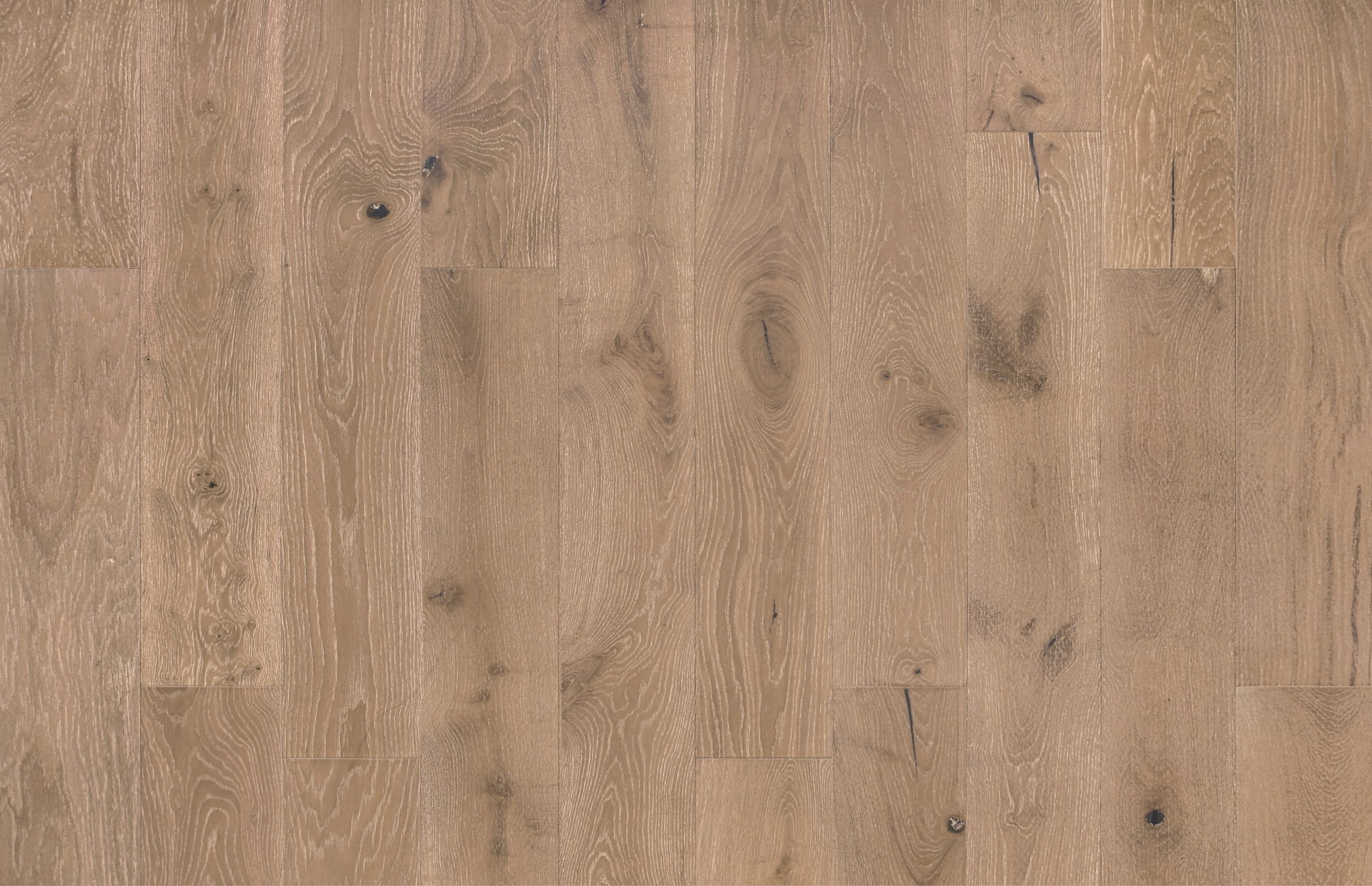
The Garrison Du Bois Gabrielle is a wire brushed Euro Oak in a Character grade with a UV Oil finish. In the photograph below it is a greige-brown oak with limed grain and small knot holes. On a surface like that, a new mark sits among existing ones rather than on its own.
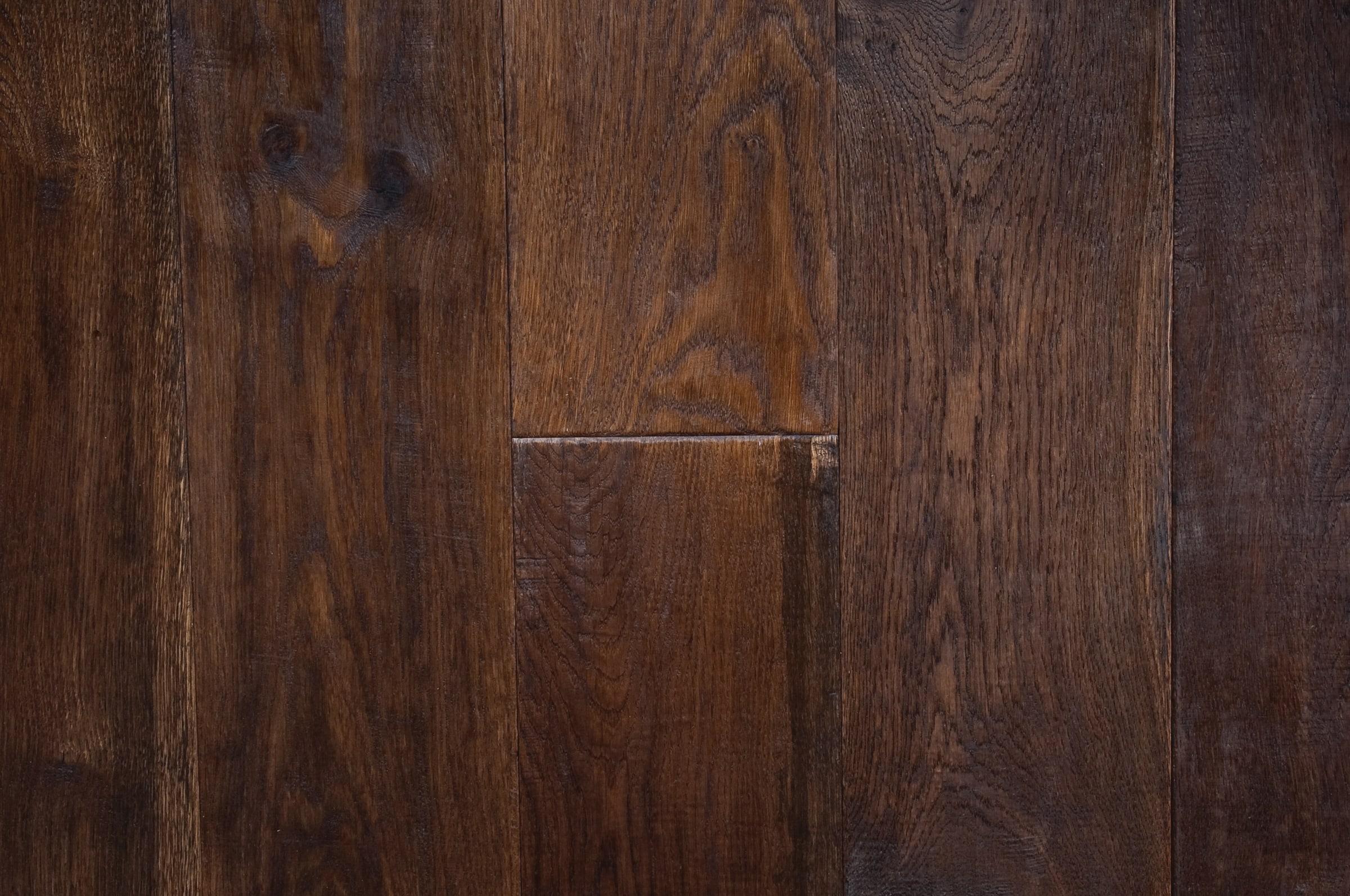
Darker floors behave the other way round. The Garrison Du Bois Brigitte is a dark espresso-brown Euro Oak with the same UV Oil finish and a wire brushed surface. Its open grain and worked texture hide wear, but pale dust and grit show on it, so a dark hall needs more sweeping than a mid-tone one.
Light, direction and the shape of the hall
Most halls get little daylight. A very dark floor in a windowless hall makes it read narrower, and a very pale one shows every grey scuff carried in from the entry. Mid-tone oak with visible grain sits between the two, which is part of why oak holds up in an entryway and in the hall beyond it.
Run the boards along the length of the hall. Boards laid across a corridor chop it into short bands and make it look shorter. Along the length, the joints lead the eye toward the far room.
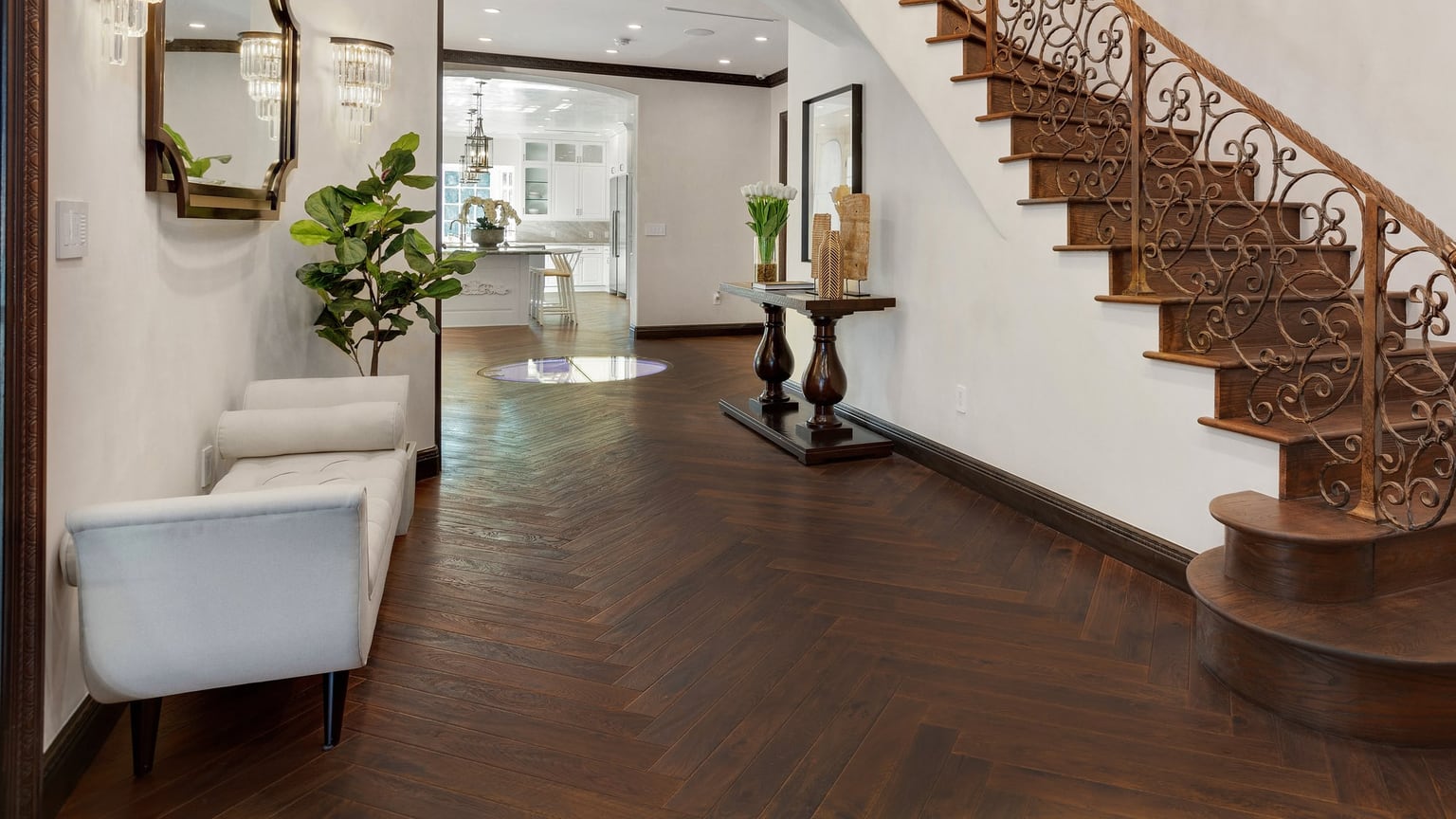
Pattern is the exception worth considering. The floor in the photograph at the top of this page is a dark oak laid in herringbone. Herringbone carries the eye forward without long joint lines, but it needs a clean stop where it meets the stair, usually a straight border board.
Where the hall meets every other room
A hall touches more rooms than most spaces do, so it collects transitions. Every doorway is a place where the new floor meets an old one, a tile, a carpet or a change in height. Count them before you choose, because each one needs a threshold piece or a careful flush joint.
Height matters on the stair more than anywhere. If new flooring raises the landing or the bottom floor, the first and last risers change height while the middle ones do not. An uneven step is the kind people trip on, so ask how the installer will keep every riser consistent.
Doors are the other quiet cost. A thicker floor can stop an interior door from clearing, which means trimming the bottom of each door that opens over the hall. That work is small, but it is easier to plan than to discover.
What we would ask before recommending a floor
We would want to see the stair before anything else. Is it open on one side or closed by walls, and what is under the treads now? Carpet often hides rough construction treads that were never meant to be seen, and that changes whether the treads are covered, replaced or finished.
We would ask whether the hall has to match floors in the rooms it connects. Matching an existing floor is often harder than replacing it, because colour and sheen change with age. Sometimes the cleaner answer is a new floor through the hall and the stair, stopping at doorways.
We would also ask who uses the stairs. Children and older relatives on a stair change the finish question toward grip. Dogs change it toward texture, because claws mark a smooth film quickly.
Common questions about hallway and stairs flooring
Can vinyl plank or laminate go on stairs?
Only where the manufacturer approves fixing the planks directly to treads and offers a way to finish the nosing. A click floor laid loose on a tread will move underfoot. Read the installation instructions for the exact product before you plan on it.
Should the stairs match the hallway floor?
Usually, yes. One species and one finish from hall to top step reads as one decision. A deliberate contrast, such as painted risers with wood treads, also works, while a near miss in colour does not.
Is solid or engineered wood better for stairs?
Both work when they are glued or nailed down. Solid wood can be sanded again when the nosing wears. An engineered board with a thick wear layer can often be refinished too, within the manufacturer's guidance.
Which finish gives more grip on stairs?
A matte or textured surface gives your foot more to hold than a semi gloss one. Wire brushed oak adds grain texture as well. Socks on smooth, shiny treads are the common cause of slips.
Do the old stair treads have to be replaced?
Not always. If the treads under the carpet are sound hardwood, they may be sanded and finished to sit with the new hall. If they are rough construction boards, they are usually capped or replaced.
The next step
A hall and stair should be measured together, because the stair changes which floors are possible and how much material you need. Before you decide, hold a sample of the floor you are considering against the top tread in your own light. When you are ready, request a quote and book a free in-home laser measurement, and we will look at the treads, the nosing and every doorway the hall touches.