
IIC and STC on a flooring spec sheet: what is a good number?
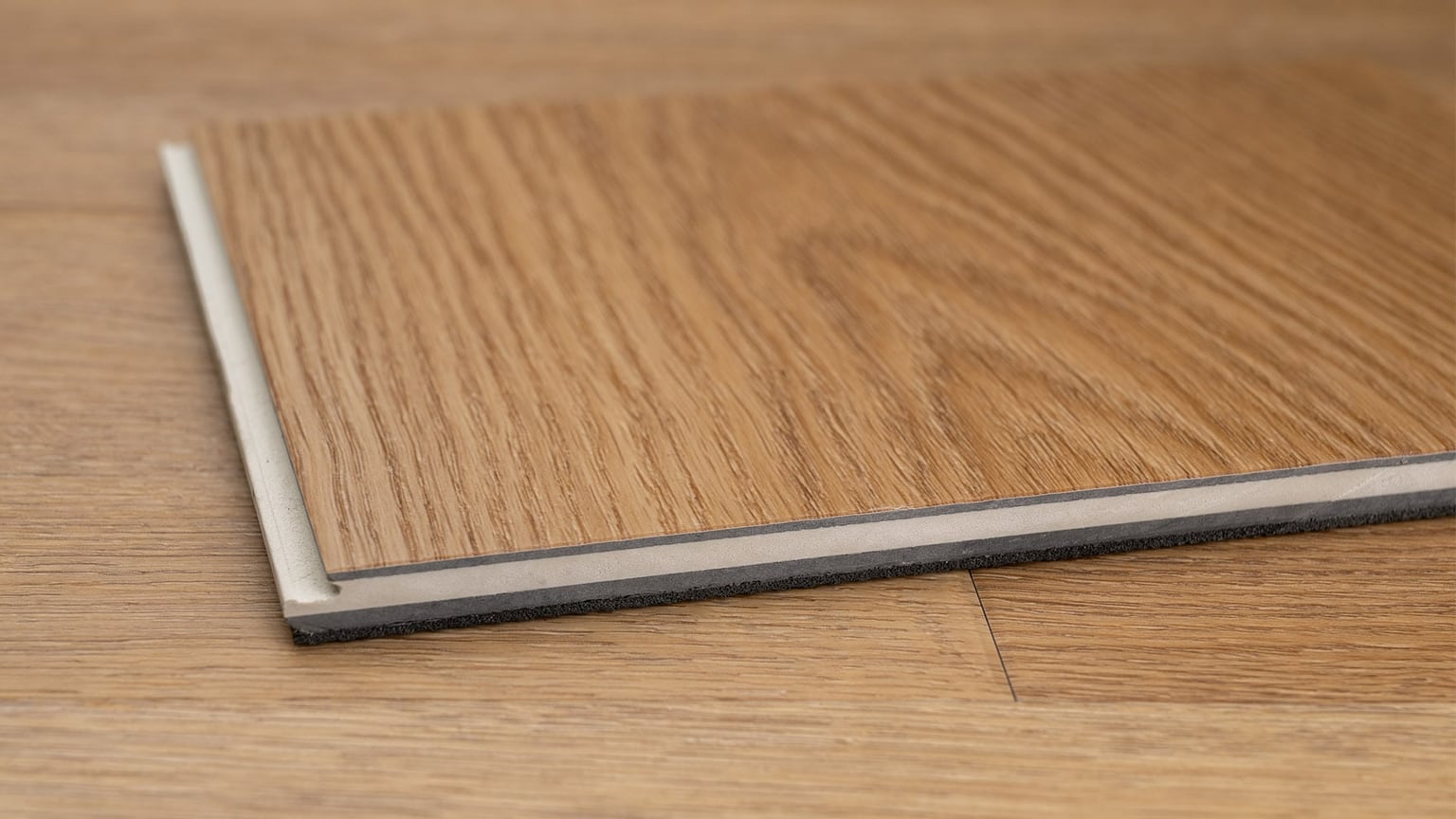
Start with the number your building requires. The 2025 California Building Code sets a minimum of 50 for IIC (footstep noise) and 50 for STC (airborne noise) between dwelling units. A field test uses different ratings, NISR for impact and NNIC for airborne sound, with a minimum of 45. Your homeowners association (HOA) may ask for more. Each number describes what was tested, such as a floor-ceiling assembly, not a plank alone.
What do IIC and STC measure?
IIC means impact insulation class. It rates footstep and impact noise, and a higher number is better. In a lab, ASTM E492 measures impact sound through a floor-ceiling assembly with a tapping machine.
STC means sound transmission class. It rates airborne noise such as speech, and a higher number is better. ASTM E90 measures airborne sound loss through building partitions and elements in a lab.
Why does a floor's number depend on how it was tested?
Lab and field results may not agree. ASTM E1007 measures impact sound in a building, in the field. Its ratings include flanking sound, meaning sound that bypasses the assembly. It says good agreement between lab and field tests on similar assemblies should not be expected.
ASTM E492 is a lab method that covers a whole assembly. It applies to floor-ceiling assemblies of all kinds, including floating floors and suspended ceilings. ASTM E2179 is different. It tests a floor covering on a standard concrete floor, in a lab only.
A 2014 WoodWorks paper shows how much the finish matters. Its Figure 12 shows six floor finishes on wood-framed floors and ceilings. The IIC values run from 38 for a bare floor to 73 for heavy carpet. Ask what a flooring number was tested on: which subfloor, which ceiling, which method.
What does Lago say about its IIC and STC ratings?
As of 8 October 2026, Lago is the only brand in our catalogue with an IIC or STC number on its listings. GAIA and GemCore list an underlayment or backing but no number, so we say nothing about their sound performance. For example, GAIA's page for its eTERRA Black Series Eyre lists an IXPE cushion, which GAIA calls "sound deadening", and states no IIC or STC number.
These are the figures Lago lists, as recorded in our catalogue:
- Lago AquaPro 10mm (for example Lochy): STC 71, IIC 70, with an 8 mm core and a 2 mm Super Acoustic Underlayment.
- Lago AquaPro Max 15mm (for example Drift Wood): STC 73, IIC 72, with a 12 mm core and a 3 mm Super Acoustic Underlayment.
- Lago Smart 6.0mm (for example Lake Chabot): STC 67, IIC 66, with a 5 mm rigid core and a 1 mm high-density underlayment.
- Lago Scratch Shield 6.5mm and Ultra Clean 6.5mm (for example Bandon and Ben Nevis): STC 69, IIC 68, with a 5 mm rigid core and a 1.5 mm IXPE Super Acoustic Underlayment.
- Lago Scratch Shield 8.5mm and Ultra Clean 8.5mm (for example Baikal and Amber): STC 73, IIC 75, with a 7 mm rigid core and a 1.5 mm IXPE Super Acoustic Underlayment.
The Lago data sheets and product pages we opened give the same numbers.
Lago says IIC and STC are "tested in labs and results may vary in different environments".
The sheets and pages do not say what slab, subfloor or ceiling the numbers came from. They do not say which test standard they used for these two numbers, or whether a figure is a whole-assembly result or a floor-covering test. All of that is not stated. We do not claim that any listed product meets a code or a building's rule.
What is a good IIC and STC for an upstairs condo?
The code sets a minimum. Your building's own rules may go higher.
Section 1206 of the 2025 California Building Code (Title 24, Part 2) applies to common interior walls, partitions and floor/ceiling assemblies. It covers those between adjacent dwelling units and sleeping units, and between them and adjacent public areas. For floor-ceiling assemblies it sets IIC 50 by ASTM E492, a field NISR of 45 by ASTM E1007, or an engineering analysis by a registered design professional. For airborne sound it sets STC 50 by ASTM E90, a field NNIC of 45 by ASTM E336, or an engineering analysis. The impact rule has an exception for floor-ceiling assemblies over nonhabitable rooms or spaces not designed to be occupied, such as garages, mechanical rooms or storage areas. We read the section on the International Code Council's digital codes site. The section text does not say whether it applies when an owner replaces a floor finish in an existing unit.
WoodWorks, writing in 2014 about mixed-use wood-frame buildings, says acoustics can be designed to meet or exceed the minimum. It also says an authority having jurisdiction can set a stricter requirement than the model code, though it calls that rarely the case.
National Hardwood, a flooring retailer writing about Southern California condos, says typical HOA minimums run IIC 55 to 65, and occasionally 70 or more in high-end high-rises. That is one retailer's claim about Southern California, not a rule. National Hardwood's checklist runs from your HOA's guidelines to third-party lab reports to written clearance before work starts.
For how core, thickness and an attached pad change feel, read rigid vinyl or laminate: core, thickness, feel. For floating floors over a concrete slab, read waterproof laminate vs SPC on a damp slab. When you are ready to compare boards, browse the flooring range.
What else do people ask about IIC and STC?
Are IIC and STC the same thing?
No. IIC rates footfall noise through a floor. STC rates how much sound a wall or floor blocks, and is aimed at speech and office noise. The code asks for both between dwelling units.
What is the difference between a lab number and a field number?
Lab figures come from a controlled test in a laboratory. Field figures come from a building, where sound can also travel around the assembly.
Can my HOA ask for more than the code?
Some do, according to one Southern California retailer. Ask your HOA for its current architectural guidelines and the exact numbers it requires.
What should I ask a flooring maker?
Ask for third-party lab test reports. Ask whether the number covers a whole floor-ceiling assembly or a floor covering on a standard concrete slab, and whether it was a lab or field test.
Where do these facts come from?
Retrieved 2026-10-08.
- ASTM International, store page for E492-09(2016)e1 (the page lists E492-25 as the active edition): https://store.astm.org/e0492-09r16e01.html
- ASTM International, store page for E90-09(2016) (the page lists E90-23 as active): https://store.astm.org/e0090-09r16.html
- ASTM International, store page for E2179-25: https://store.astm.org/e2179-25.html
- ASTM International, store page for E1007-16 (the page lists E1007-25 as the active edition): https://store.astm.org/e1007-16.html
- International Code Council, 2025 California Building Code, Title 24, Part 2, Volumes 1 and 2, with January 2026 errata, Chapter 12, sections 1206.1 to 1206.3: https://codes.iccsafe.org/content/CABC2025P2/chapter-12-interior-environment
- WoodWorks, Acoustical Considerations for Mixed-Use Wood-Frame Buildings (Thorburn Associates, June 2014, written against the 2012 IBC): https://www.woodworks.org/wp-content/uploads/Acoustics_Solutions_Paper.pdf
- Lago Flooring, Technical Data Sheet for Scratch Shield 6.5MM and 8.5MM (PDF created 2026-03-03, image-only, read visually): https://619200e5-734e-4d17-b6e5-8aa000e2883b.filesusr.com/ugd/a220e6_29f737f5885c4395866957dfad5b4a8d.pdf
- Lago Flooring, Technical Data Sheet for AquaPro 10MM and AquaPro Max 15MM (PDF created 2026-03-03, image-only, read visually): https://619200e5-734e-4d17-b6e5-8aa000e2883b.filesusr.com/ugd/a220e6_36dfeb74d33f4e058b2a20f0b8585f12.pdf
- Lago Flooring, Technical Data Sheet for Smart 6.0MM (PDF created 2026-03-03, image-only, read visually): https://619200e5-734e-4d17-b6e5-8aa000e2883b.filesusr.com/ugd/a220e6_9561d6d3b70f46a5aefbcba36f8d7cce.pdf
- Lago Flooring, Technical Data Sheet for Ultra Clean 6.5MM and 8.5MM (PDF created 2026-03-03, image-only, read visually): https://619200e5-734e-4d17-b6e5-8aa000e2883b.filesusr.com/ugd/a220e6_6a8c9e9c1dfd4ee7bd579a059f3a7efa.pdf
- Lago Flooring, product pages: https://www.lagoflooring.com/product-page/product-302
- Lago Flooring, product page for Smart 6.0MM: https://www.lagoflooring.com/product-page/product-st001
- GAIA, eTERRA Black Series Eyre product page: https://gaiafloor.com/eyre
- National Hardwood Flooring and Moulding (a flooring retailer), IIC and STC Ratings Explained for Multi-Family Flooring: https://nationalhardwood.com/iic-and-stc-ratings-hardwood-floors/