
Laminate or vinyl on a slab: what water-resistant means
If you are deciding between laminate or vinyl on a slab that holds moisture, choose vinyl. Water-resistant laminate still has a core made of compressed wood fibre. Its protection is aimed at spills on top, not at damp rising out of the concrete underneath.
Vinyl has no wood in its core, so moisture from below does not swell it. That does not make a wet slab acceptable, and it does not make every vinyl the same. The reading taken on the concrete, and the way the floor is built and laid, matter more than the word printed on the carton.
What "water-resistant" is actually describing
On a laminate carton, "water-resistant" usually describes the top of the floor. The wear surface and the coated joints are designed to stop a spilled glass or wet shoes from soaking into the seams before you wipe them up. That is useful in a kitchen or an entry, and it is a real improvement on older laminate.
It says much less about the bottom of the plank. A laminate core is fibreboard: wood particles pressed together with resin. When that core takes on water for long enough, it swells at the edges, and swollen fibreboard does not shrink back flat.
A slab that holds moisture does not deliver one spill. It delivers a slow, steady supply of vapour against the underside of the floor for as long as the floor is down. That is the condition water-resistant laminate is least built for, and it is why the label on the carton is the wrong place to start.
Why a concrete slab changes the answer
Concrete looks dry and still moves water. A slab poured on grade sits on soil, and unless a vapour barrier was placed under it when it was poured, ground moisture can travel up through it. Many older slab-on-grade houses across the Bay Area and out into the Central Valley were built without one.
You usually cannot see the problem from the surface. The warning signs are a white powdery bloom on bare concrete, a musty smell under old carpet, curling vinyl tiles, or carpet tack strip that has rusted. A garage conversion or a step-down family room is a common place to find them.
The new floor then sits between that damp concrete and the drier air of the room. Whatever it is made of, it will see that vapour on its underside. The real question is how its core reacts when it does.
How laminate and vinyl behave over damp concrete
Laminate fails from the edges. Moisture reaches the joints from below, the fibreboard swells, and the edges lift into a ridge you can feel underfoot. The printed decor on top may still look fine while the core underneath has already changed shape.
Vinyl does not swell that way, because there is no wood fibre to absorb water. The risk with vinyl over a damp slab is different: moisture can be trapped between the concrete and the plank, where it has nowhere to go. That is why the underlayment, the vapour barrier and the installation method still decide whether a vinyl floor works.
For a closer look at how the two cores are built and how they feel, our piece on rigid vinyl or laminate: core, thickness and feel goes through it plank by plank. Here the core is the whole decision, and on a damp slab it points one way.
What to check on your own slab before you choose
Start with a moisture test on the slab itself, not a guess from the look of the room. Floor makers state how the concrete should be tested and what result their floor will accept. Have it tested the way the manufacturer's installation instructions specify, before you commit to a material.
Then check what is already under the old floor. Look for an existing barrier, old adhesive, cracks, and any low spots or humps. A floating floor needs a flat slab, and a crack that seeps after rain tells you more than any carton will.
Last, decide how the floor will be separated from the concrete. Most floating floors over concrete call for a vapour barrier film beneath them, and some planks arrive with a pad already attached. Our guide on how to choose underlayment for a new floor explains when an attached pad is enough and when the slab needs more.
Which vinyl construction suits a damp slab
Not every vinyl is built the same, and the differences show up on concrete. Our range covers three broad builds: rigid core plank that floats on a click joint, thicker composite plank that also floats, and thin plank that is glued down.
Rigid stone-composite core is the stiffest of these. Garrison Metropolitan Nolita is SPC construction, 6.5mm thick, with a 0.5 mm (20 mil) wear layer, and it floats on a click joint. A stiff core bridges small imperfections in the slab better than a soft one, though it still needs the flatness the instructions ask for.
Garrison AquaBlue II WPC Bronze is listed as SPC construction as well, at 6.5mm thick. In a plain, bright room it reads as a dark walnut-brown plank, and on a slab it behaves like the rest of the rigid core group.

Wood-plastic composite core is thicker and a little softer underfoot. Garrison AquaBlue II WPC Zion Oak is WPC construction, 12mm thick and 9" wide, with a 0.5 mm (20 mil) wear layer. The extra thickness adds comfort and quiet, and it also raises the finished floor height you need to plan around at doorways.
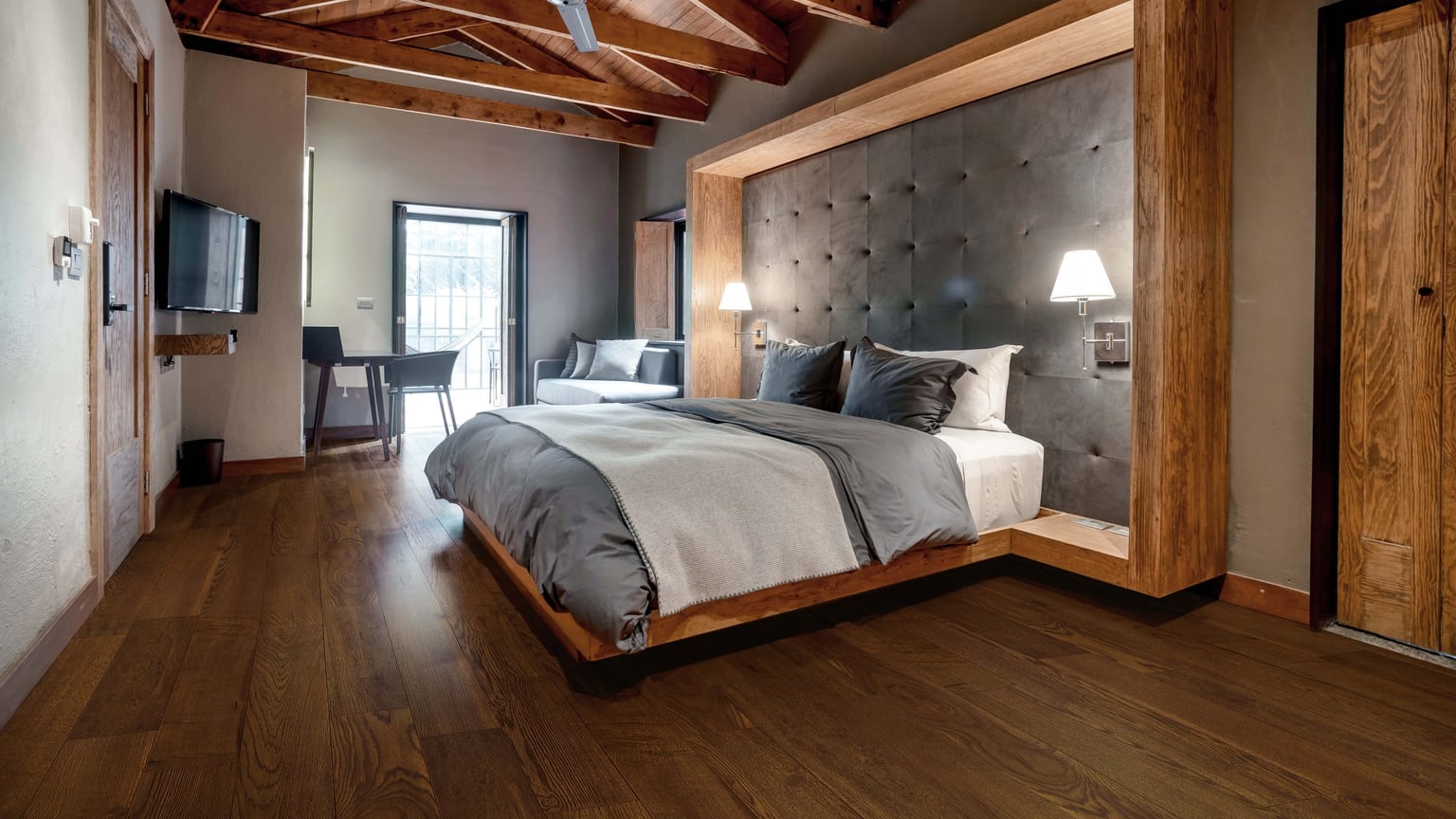
WSPC sits between the two. Garrison Zodiac W-SPC Scorpio is WSPC construction in Euro Oak, 8mm thick and 7.5" wide, with a 1.2 mm wear layer and an IXPE substrate. The Garrison Zodiac W-SPC Libra in the photograph at the top of this page comes from the same collection.
Glue-down plank is the other route. Garrison Country Charm Adelaide is LVT glue-down, 3mm thick, with a 20 mil wear layer. Glue-down sits tight to the concrete, so the adhesive and the slab reading have to suit each other, and the adhesive maker's limits apply as much as the floor's.
Duchateau's rigid core planks float on a click joint over their own underlayment. Duchateau LUXETECH 20 Barris is a rigid core vinyl plank, 228mm wide and 8mm thick, with a 5G Click floating install and HushWalk underlayment. That pad changes how the floor sounds on concrete, and the installation instructions still decide what goes between it and the slab.

Where vinyl is still the wrong answer
Vinyl is the safer core over a damp slab, but it is not a fix for water. If the slab seeps liquid water after rain, or the room floods from a failed appliance, no floor in this article will save it. The source of the water needs dealing with before any floor goes down.
Vinyl has trade-offs of its own. It feels and sounds different from wood, and a thin glue-down plank telegraphs every bump in the concrete. A thick floating plank adds height that can catch a door or meet a neighbouring floor awkwardly.
Laminate is not a bad floor, either. Over a dry slab, with the barrier its maker asks for, water-resistant laminate can be a sound choice for a bedroom or a hall. It is the damp slab, specifically, that tips the answer toward vinyl.
Common questions about laminate or vinyl on a slab
Can water-resistant laminate go on a concrete slab at all?
Yes, when the slab tests dry and the manufacturer's vapour barrier goes down first. The trouble starts when the slab holds moisture, because the fibreboard core reacts to damp from below.
Is vinyl plank waterproof on concrete?
We do not describe any floor in this article as waterproof. A vinyl core does not swell with water, but moisture can still collect beneath it, so the slab test and the barrier still matter.
Do I need a vapour barrier under vinyl on a slab?
Often, yes. Follow the manufacturer's installation instructions for the exact plank, including when an attached pad counts as enough and when a separate film is required.
Is SPC or WPC the safer choice for a damp slab?
Neither core contains wood fibre. SPC is stiffer and usually thinner, while WPC is thicker and softer underfoot. The flatness of your slab and the floor height you can allow usually decide between them.
How do I know if my slab holds moisture?
A moisture test on the concrete tells you, and the look of the surface does not. White powder, a musty smell or curling old tiles are all reasons to test before you choose.
Should vinyl be floated or glued down on a damp slab?
Either can work when the slab result suits the floor and the adhesive. Floating plank tolerates small imperfections better, while glue-down sits lower and needs a flatter, better-prepared surface.
The next step is a reading, not a guess. Book a free in-home laser measurement, then compare the rigid core, composite and glue-down planks in the full flooring range once you know what your concrete is doing.